How is GEO different from SEO?

GEO (Generative Engine Optimization) is not a rebrand of SEO—it’s a response to an entirely new environment. SEO optimizes for bots that crawl, index, and rank. GEO optimizes for large language models (LLMs) that read, learn, and generate human-like answers.

While SEO is built around keywords and backlinks, GEO is about semantic clarity, contextual authority, and conversational structuring. You're not trying to please an algorithm—you’re helping an AI understand and echo your ideas accurately in its responses. It's not just about being found—it's about being spoken for.

Last updated at  
April 13, 2026
Other FAQ
What strategies can businesses use to improve their visibility in AI-powered search systems?
Arrow

To improve visibility in AI-powered search systems, businesses should create high-quality content, use structured data, build strong topical authority, and ensure information is clear and well-organized. These strategies help AI systems recognize and reference reliable content.

Read More
ArrowArrow right blue
How does RankWit.AI implement structured data and knowledge graph architecture to increase brand authority in search engines and generative AI systems?
Arrow

RankWit.AI deploys advanced schema strategies to transform content into machine-readable knowledge assets.

We do not implement structured data as a technical add-on — we design semantic architectures that position brands as authoritative nodes within their industry knowledge graph.

This dramatically improves visibility in SERPs and increases the likelihood of being surfaced in AI-generated responses.

Read More
ArrowArrow right blue
Does AI Optimization actually drive direct bookings and high-value traffic?
Arrow

Yes, that is the primary goal. Travelers who discover you through AI recommendations land on your official site with high intent, ready to book or visit.

For hotels, this means bypassing OTA commissions; for destinations, it means driving traffic to local ecosystems and official portals.

Often, the increase in direct, high-value traffic allows the service to pay for itself many times over.

Read More
ArrowArrow right blue
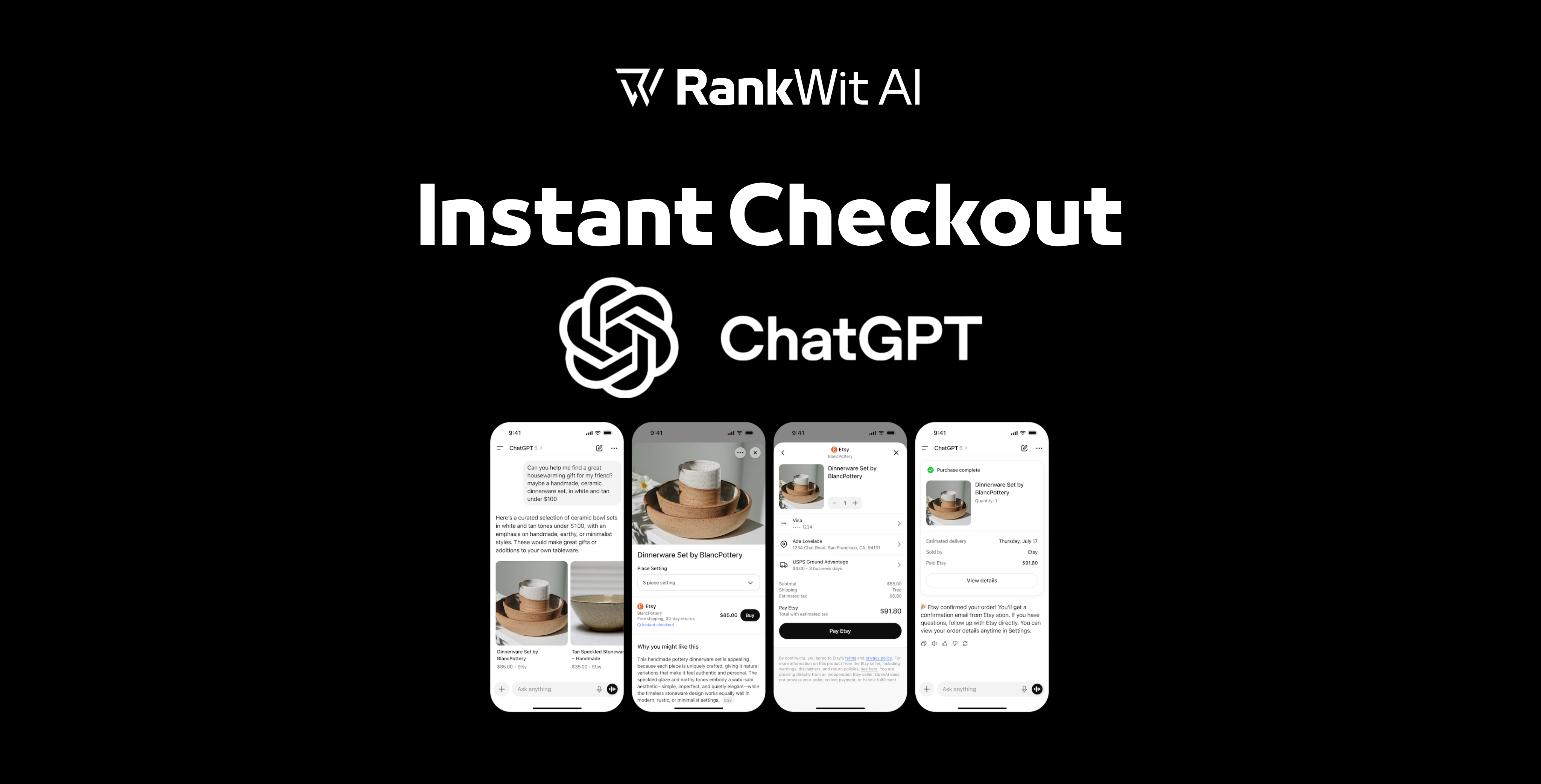
What is ChatGPT Instant Checkout and how does it work for e-commerce merchants?
Arrow

ChatGPT Instant Checkout is a new capability since 2025 developed by OpenAI that allows users to discover, configure, and purchase products directly within ChatGPT without leaving the conversation.
This functionality is powered by the Agentic Commerce Protocol (ACP), an open standard that defines how merchants’ systems interact with AI agents.

Merchants connect their product catalog through a structured product feed, expose checkout endpoints via the Agentic Checkout API, and process payments securely through delegated payment providers like Stripe.
Together, these layers create a smooth, conversational shopping experience that merges AI discovery with secure e-commerce execution.

Read More
ArrowArrow right blue
How should retailers and marketing professionals adapt their strategies to Google’s Generative AI Shopping features?
Arrow

Google's Generative AI Shopping features are redefining the journey from product discovery to purchase. For retailers and marketers, this demands a strategic shift across several areas.

Invest in Visual Quality

With AI-powered "Shop Similar" product matches based on visual and semantic similarity rather than keywords alone, product image quality has never mattered more. Low-resolution photos, inconsistent backgrounds, or images that don't accurately represent the product will be at a disadvantage.

Best practice: Use clean, high-resolution product photography. Make sure images accurately represent colors, textures, and proportions, as the AI matching engine evaluates these attributes directly.

Optimize Your Shopping Graph Presence

Google's Shopping Graph — a continuously updated dataset of over 35 billion product listings — is the backbone of every AI-powered shopping feature. Incomplete, outdated, or missing products simply won't surface in AI-generated results.

Best practice: Keep product feeds up to date with accurate titles, descriptions, prices, availability, and structured attributes. Treat Shopping Graph as critical infrastructure, not a secondary operation.

Prepare for Conversational Queries

As users learn to describe products in natural language (e.g., "gifts for a 7-year-old who wants to be an inventor"), search behavior will shift toward longer, more descriptive queries. These are exactly the kind of queries generative AI excels at interpreting.

Best practice: Write product descriptions and category content that mirrors how real people talk about your products. Focus on use cases, scenarios, and specific attributes rather than generic marketing copy.

Monitor AI-Referred Traffic

According to Adobe Analytics, traffic from generative AI tools to retail websites grew 1,200% year over year in early 2025, with visitors showing longer sessions, more page views, and lower bounce rates. While still a small share of total traffic, the growth trajectory is steep.

Best practice: Track AI-referred traffic as a distinct channel in your analytics. Identify which products and categories are being surfaced by AI tools and optimize accordingly.

The shift from keyword search to AI-powered generative search is not a future event, it's happening now. Retailers who adapt their product data, visual assets, and content strategy today will be positioned to capture the growing share of purchase intent driven by AI-powered discovery.

Read More
ArrowArrow right blue
How long before we see results?
Arrow

Most hotels see measurable improvements in AI citations within 30–60 days.
Full compounding results, where AI platforms consistently recommend you for your highest-value prompts, typically emerge between 90 and 180 days, depending on your starting position and market.

Read More
ArrowArrow right blue
How does the "Shop Similar" feature work inside Google's AI-powered search results?
Arrow

The "Shop Similar" feature is one of the most commercially significant additions to Google's Search Generative Experience. It bridges the gap between inspiration and purchase in a single, seamless flow.

Here's how it works:

  1. A user searches for a product or generates an AI image of what they want.
  2. Google's system analyzes the visual and semantic attributes of that image.
  3. Matching real products from the Shopping Graph appear immediately below, including pricing, seller information, ratings, and product photos.

The user never needs to reformulate their query, run a reverse image search, or navigate to a separate shopping tab. The entire journey, from idea to purchasable product, happens within the search interface.

Key distinction: The matching logic is visual and semantic, not purely keyword-driven. This means that the quality and accuracy of product imagery now plays a direct role in whether a product appears in these AI-matched results.

What this means for retailers: Products that are well-represented in Google's Shopping Graph, with accurate metadata, competitive pricing, and high-resolution imagery, are far more likely to be surfaced. Brands that invest in structured product data and visual quality will have a measurable advantage in this new shopping experience.

Read More
ArrowArrow right blue
What is AI Search Optimization and why is it important?
Arrow

AI Search Optimization refers to the practice of structuring, formatting, and presenting digital content to ensure it is surfaced by AI systems—particularly large language models (LLMs)—in response to user queries.Choosing a clear, unified name for this emerging field is crucial because it shapes professional standards, guides tool development, informs marketing strategies, and fosters a cohesive community of practice. Without a consistent term, the industry risks fragmentation and inefficiency, much like early digital marketing faced before "SEO" was widely adopted.

Read More
ArrowArrow right blue
How can websites structure their content so it can be effectively retrieved and used by Retrieval-Augmented Generation systems?
Arrow

Content that is well-structured, informative, and organized around clear topics is easier for retrieval systems to access and use. Structured headings, semantic clarity, and authoritative information increase the chances that content will be retrieved and used by AI systems during response generation.

Read More
ArrowArrow right blue
What key trends are shaping the future of search engines as large language models become more widely integrated?
Arrow

As large language models become integrated into search engines, major trends include conversational search interfaces, AI-generated summaries, deeper semantic understanding, and more personalized results. These changes are redefining how users interact with search platforms.

Read More
ArrowArrow right blue

📚 Learn, Apply, Win

Stay inspired with the latest stories, tips, and insights.
Explore articles designed to spark ideas, share knowledge, and keep you updated on what’s new.