How are large language models used in modern search engines, digital platforms, and AI-powered applications?

Large language models power many modern technologies, including AI assistants, conversational search systems, automated content generation, and customer support tools. Their ability to interpret natural language allows digital platforms to deliver more intelligent and interactive experiences.

Last updated at  
April 13, 2026
Other FAQ
What types of metrics are most useful for evaluating performance in AI-driven search environments?
Arrow

AI search performance metrics are the new frontier for digital marketers. As generative engines like Gemini and Search Generative Experience (SGE) redefine how users find information, relying solely on legacy SEO tracking is no longer enough. To succeed, you must measure how AI models perceive, rank, and cite your content.

1. Subjective ImpressionThis metric evaluates how well your content answers user queries compared to competitors. AI models assess the relevance, completeness, and accuracy of your content. A high score signifies that your content provides comprehensive answers that LLMs deem most helpful to the user.

2. Position ScoreSimilar to traditional SERP rankings, the Position Score measures how high your website ranks within the AI’s generated response. Calculated by your average ranking position (1st, 2nd, 3rd), a higher position directly correlates with increased user trust and higher click-through potential from AI citations.

3. Share of Voice (SoV)In the context of GEO, Share of Voice measures the percentage of queries where your website is mentioned or cited in the AI's response. A dominant SoV indicates broad topical authority and ensures your brand remains "top of mind" for the AI across various related search strings.

4. Consistency ScoreBecause users interact with various models (Perplexity, ChatGPT, Gemini), the Consistency Score is vital. It tracks the similarity of your rankings and mentions across multiple platforms. High consistency ensures that your brand’s authority is recognized universally, regardless of the specific AI model used.

Read More
ArrowArrow right blue
Why are brand mentions and media coverage important for visibility in AI-driven search environments?
Arrow

AI-powered search systems analyze brand mentions, citations, and references across the web to evaluate credibility. When a brand is consistently mentioned by authoritative sources, it becomes easier for AI systems to recognize its expertise and include it in search results or generated answers.

Read More
ArrowArrow right blue
Can I keep working with my current marketing agency or internal team?
Arrow

Absolutely. RankWit works in parallel with your current team, whether internal or external.

We manage the AI visibility layer (AIO) that traditional marketing partners often aren't equipped to handle yet.

We share all our data and insights so your team maintains full strategic control, integrating AI insights into your broader marketing mix.

Read More
ArrowArrow right blue
What is ChatGPT Instant Checkout and how does it work for e-commerce merchants?
Arrow

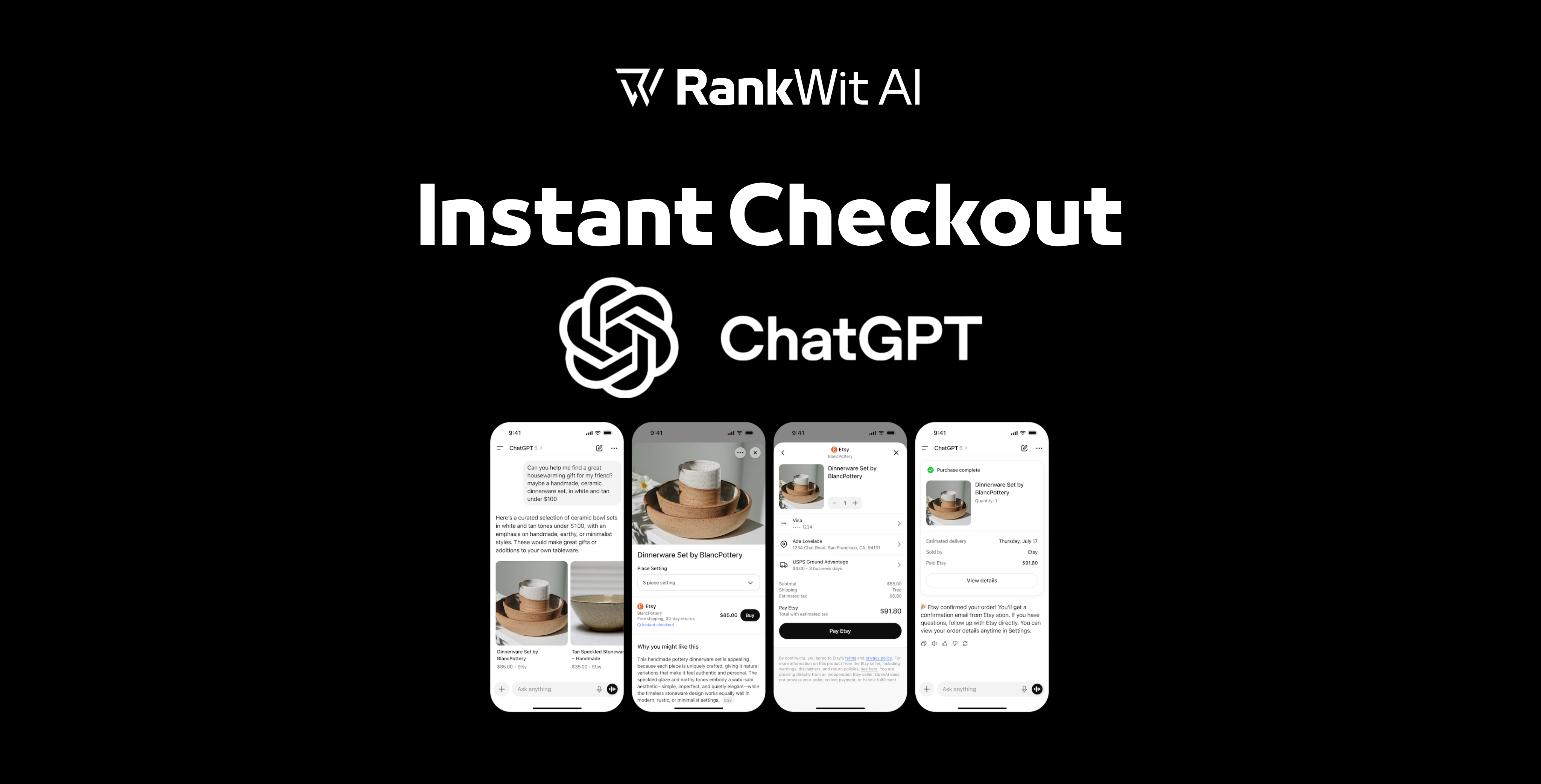
ChatGPT Instant Checkout is a new capability since 2025 developed by OpenAI that allows users to discover, configure, and purchase products directly within ChatGPT without leaving the conversation.
This functionality is powered by the Agentic Commerce Protocol (ACP), an open standard that defines how merchants’ systems interact with AI agents.

Merchants connect their product catalog through a structured product feed, expose checkout endpoints via the Agentic Checkout API, and process payments securely through delegated payment providers like Stripe.
Together, these layers create a smooth, conversational shopping experience that merges AI discovery with secure e-commerce execution.

Read More
ArrowArrow right blue
Why is understanding user intent essential for creating content that performs well in modern search engines?
Arrow

Understanding user intent allows businesses to create content that directly answers user questions and needs. When content aligns with search intent, search engines are more likely to consider it relevant and display it in search results.

Read More
ArrowArrow right blue
What strategies can businesses use to strengthen their authority signals for AI-powered search systems?
Arrow

Businesses can strengthen their AI authority by earning media coverage, publishing expert content, building high-quality backlinks, and maintaining consistent brand mentions across trusted platforms. These signals help AI systems identify the brand as a reliable source within its industry.

Read More
ArrowArrow right blue
What is AI search optimization and how does it help websites remain visible in modern AI-powered search environments?
Arrow

AI search optimization involves structuring and optimizing content so artificial intelligence systems can interpret, analyze, and reference it effectively. This includes focusing on semantic relevance, clear content structure, entity signals, and authoritative information.

Read More
ArrowArrow right blue
What criteria should organizations use to evaluate and select the most suitable AI platform for scalability, performance, security, and long-term return on investment?
Arrow

Within our ecosystem, we evaluate AI platforms based on real profitability criteria. We do not simply look for the most popular infrastructure, but for platforms that offer robust APIs, enterprise-grade data security, and native integration with existing systems to ensure immediate return on investment.

Read More
ArrowArrow right blue
How can I optimize for GEO?
Arrow

GEO requires a shift in strategy from traditional SEO. Instead of focusing solely on how search engines crawl and rank pages, Generative Engine Optimization (GEO) focuses on how Large Language Models (LLMs) like ChatGPT, Gemini, or Claude understand, retrieve, and reproduce information in their answers.

To make this easier to implement, we can apply the three classic pillars of SEO—Semantic, Technical, and Authority/Links—reinterpreted through the lens of GEO.

1. Semantic Optimization (Text & Content Layer)

This refers to the language, structure, and clarity of the content itself—what you write and how you write it.

🧠 GEO Tactics:

  • Conversational Clarity: Use natural, question-answer formats that match how users interact with LLMs.
  • RAG-Friendly Layouts: Structure content so that models using Retrieval-Augmented Generation can easily locate and summarize it.
  • Authoritative Tone: Avoid vague or overly promotional language—LLMs favor clear, factual statements.
  • Structured Headers: Use H2s and H3s to define sections. LLMs rely heavily on this hierarchy for context segmentation.

🔍 Compared to Traditional SEO:

  • Similarity: Both value clarity, keyword-rich subheadings, and topic coverage.
  • Difference: GEO prioritizes contextual relevance and direct answers over keyword stuffing or search volume targeting.

2. Technical Optimization

This pillar deals with how your content is coded, delivered, and accessed—not just by humans, but by AI models too.

⚙️ GEO Tactics:

  • Structured Data (Schema Markup): Clearly define entities and relationships so LLMs can understand context.
  • Crawlability & Load Time: Still important, especially when LLMs like ChatGPT or Perplexity use live browsing.
  • Model-Friendly Formats: Prefer clean HTML, markdown, or plaintext—avoid heavy JavaScript that can block content visibility.
  • Zero-Click Readiness: Craft summaries and paragraphs that can stand alone, knowing the user may never visit your site.

🔍 Compared to Traditional SEO:

  • Similarity: Both benefit from clean code, fast performance, and schema markup.
  • Difference: GEO focuses on how readable and usable your content is for AI, not just browsers.

3. Authority & Link Strategy

This refers to the signals of trust that tell a model—or a search engine—that your content is reliable.

🔗 GEO Tactics:

  • Credible Sources: Reference reliable, third-party data (.gov, .edu, research papers). LLMs often echo content from trusted domains.
  • Internal Linking: Connect related content pieces to help LLMs understand topic depth and relationships.
  • Brand Mentions: Even unlinked brand citations across the web may boost your perceived credibility in LLMs’ training and inference models.

🔍 Compared to Traditional SEO:

  • Similarity: Both reward strong domain reputation and high-quality references.
  • Difference: GEO may rely more on accuracy and perceived authority across training data than on backlink volume or anchor text.

Read More
ArrowArrow right blue
How can B2B companies adapt their digital marketing strategies to remain visible in AI-powered search engines and generative search platforms?
Arrow

To stay visible in AI-powered search environments, B2B companies must optimize content for semantic relevance, entities, and machine-readable signals. This includes creating authoritative content, implementing structured data, and building strong topical authority so AI systems can accurately understand and reference their expertise.

Read More
ArrowArrow right blue

📚 Learn, Apply, Win

Stay inspired with the latest stories, tips, and insights.
Explore articles designed to spark ideas, share knowledge, and keep you updated on what’s new.