📚 Learn, Apply, Win
Explore articles designed to spark ideas, share knowledge, and keep you updated on what’s new.
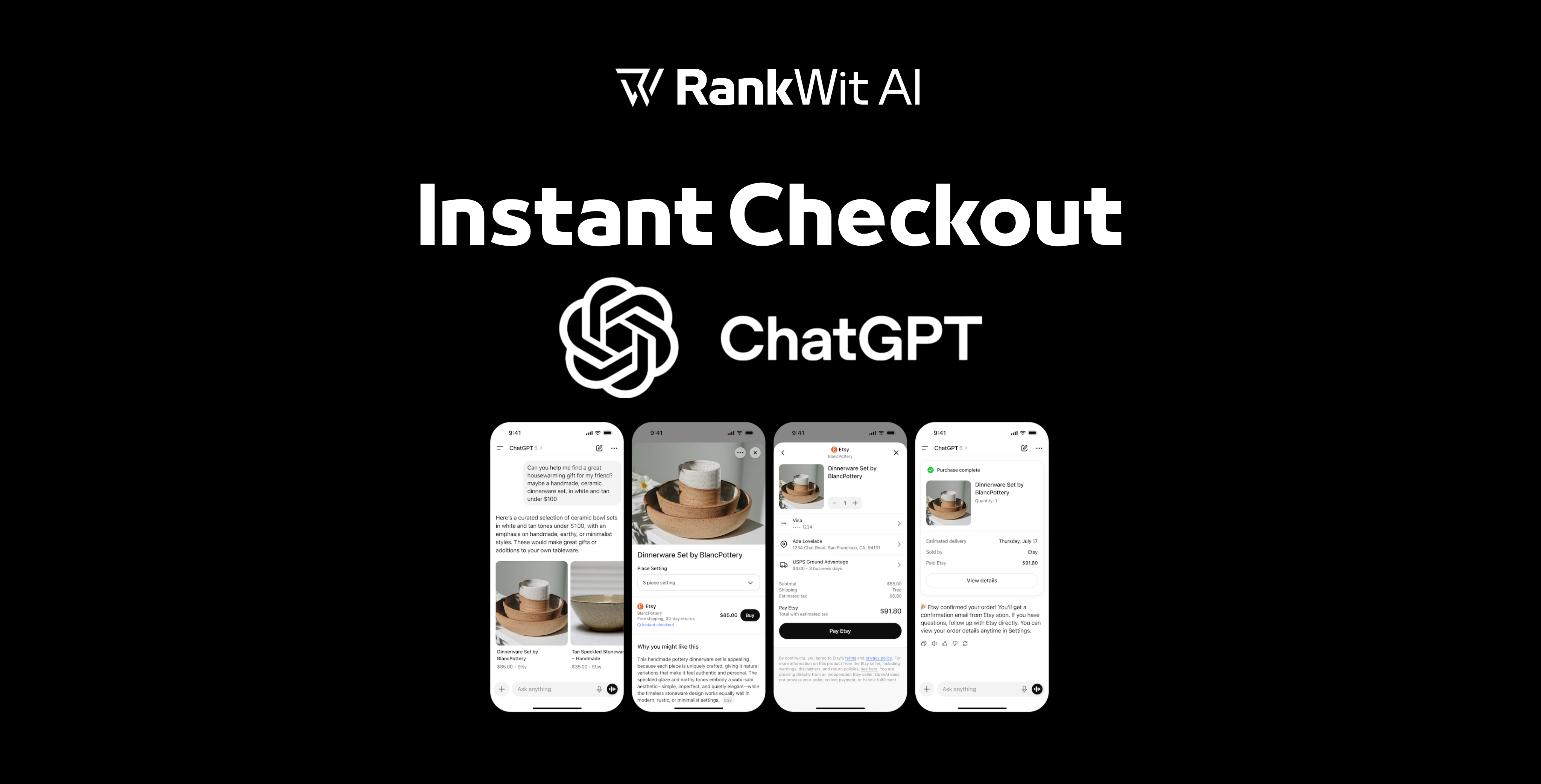
At Rankwit, we specialize in helping merchants take advantage of OpenAI’s Agentic Commerce Protocol (ACP).
Our team manages the entire integration lifecycle, from mapping your product catalog to OpenAI’s structured feed specification, to building the checkout API endpoints and connecting secure payment providers like Stripe.
By partnering with Rankwit, your business can:
We tailor solutions to both enterprise and custom e-commerce platforms, ensuring a scalable and future-ready architecture.
Google's AI-powered Virtual Try-On is a Google Shopping feature that uses generative AI to show how a specific garment looks on a real model matching the shopper's preferences.
Users can choose from 40 models varying in:
This helps shoppers make more confident purchase decisions without visiting a physical store, solving one of the biggest friction points in online apparel shopping: uncertainty about fit and appearance.
Google reported that products with Virtual Try-On enabled received significantly higher quality engagement, meaning shoppers spent more time interacting with those listings and were more likely to take actions such as clicking through or completing a purchase.
As Google extends Virtual Try-On to additional categories, brands that participate in the program and provide standardized, high-quality product images will benefit from stronger engagement signals and greater conversion potential. This feature is a clear indicator that visual content quality is becoming a ranking factor in AI-powered shopping experiences.
RankWit is designed for anyone who wants to maximize their brand’s visibility on AI platforms. The main users include:
- Freelancers: Stand out by offering clients AI-optimized content services.
- Agencies: Add GEO to your service portfolio and stay ahead of competitors.
- Brands: Protect and expand your presence so that AI cites your company, not someone else’s.
Whether you work independently or as part of a larger marketing team, RankWit provides tools to monitor, optimize, and grow in the age of AI search.
Large Language Models (LLMs) are AI systems trained on massive amounts of text data, from websites to books, to understand and generate language.
They use deep learning algorithms, specifically transformer architectures, to model the structure and meaning of language.
LLMs don't "know" facts in the way humans do. Instead, they predict the next word in a sequence using probabilities, based on the context of everything that came before it. This ability enables them to produce fluent and relevant responses across countless topics.
For a deeper look at the mechanics, check out our full blog post: How Large Language Models Work.
Structured data uses standardized formats like schema markup to explain the meaning of your content to search engines. This allows platforms like Google and AI-powered search systems to better interpret your pages, connect them with relevant entities, and potentially display enhanced results such as rich snippets or knowledge panels.
Shopping Research is a feature in ChatGPT that acts as a personalized shopping assistant.
Simply describe what you’re looking for, such as “a lightweight laptop for travel”, and ChatGPT gathers product details, reviews, specs, prices, and comparisons from the web.
You can refine the results by marking products as “Not interested” or “More like this”, helping ChatGPT understand your preferences.
At the end, you receive a custom buyer’s guide that explains the pros, cons, and trade-offs of each option, making your purchase process easier and more informed.
RankWit continuously scans generative AI engines like ChatGPT, Gemini, and Perplexity to see if, when, and how your content is referenced. We then aggregate this data into an easy-to-read dashboard, showing: