When will we start seeing the first results for our destinations?

Most tourism organizations see measurable improvements in AI citations and recommendations within 30–60 days.

Full and cumulative results typically emerge between 90 and 180 days, depending on the initial positioning of the territories and the complexity of the target tourism markets.

Last updated at  
April 27, 2026
Other FAQ
Does AI Optimization actually drive direct bookings and high-value traffic?
Arrow

Yes, that is the primary goal. Travelers who discover you through AI recommendations land on your official site with high intent, ready to book or visit.

For hotels, this means bypassing OTA commissions; for destinations, it means driving traffic to local ecosystems and official portals.

Often, the increase in direct, high-value traffic allows the service to pay for itself many times over.

Read More
ArrowArrow right blue
Which generative AI tools deliver the greatest productivity gains for business teams in content creation, software development, automation, and data analysis?
Arrow

Our AI-driven product selection focuses on eliminating operational bottlenecks. We implement solutions that enable creative and technical teams to automate documentation and data analysis, allowing them to focus on high-level strategy and innovation.

Read More
ArrowArrow right blue
How can Rankwit help my business integrate with ChatGPT’s Agentic Commerce Protocol?
Arrow

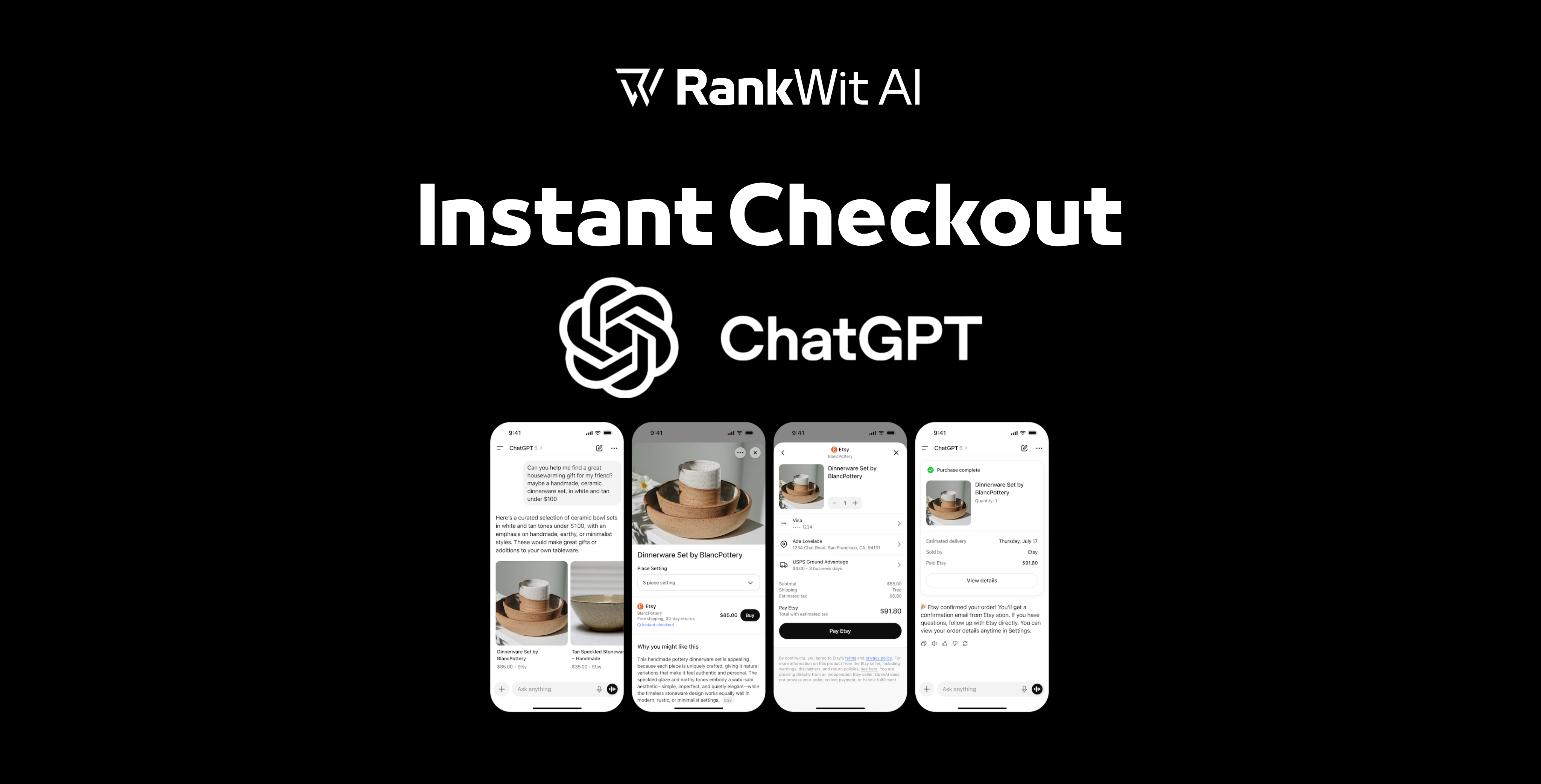
At Rankwit, we specialize in helping merchants take advantage of OpenAI’s Agentic Commerce Protocol (ACP).
Our team manages the entire integration lifecycle, from mapping your product catalog to OpenAI’s structured feed specification, to building the checkout API endpoints and connecting secure payment providers like Stripe.

By partnering with Rankwit, your business can:

  • Launch AI-powered conversational shopping experiences inside ChatGPT.
  • Achieve full compliance with OpenAI and PCI DSS standards.
  • Gain an unfair competitive advantage by adopting this technology before it becomes mainstream.

We tailor solutions to both enterprise and custom e-commerce platforms, ensuring a scalable and future-ready architecture.

Read More
ArrowArrow right blue
What is LLM optimization and how does it help content become more understandable for large language models?
Arrow

LLM optimization involves structuring and writing content so large language models can easily understand, process, and reference it. This includes clear explanations, logical structure, semantic context, and reliable information that AI systems can interpret accurately.

Read More
ArrowArrow right blue
What is ChatGPT Shopping Research and how does it work?
Arrow

Shopping Research is a feature in ChatGPT that acts as a personalized shopping assistant.
Simply describe what you’re looking for, such as “a lightweight laptop for travel”, and ChatGPT gathers product details, reviews, specs, prices, and comparisons from the web.

You can refine the results by marking products as “Not interested” or “More like this”, helping ChatGPT understand your preferences.

At the end, you receive a custom buyer’s guide that explains the pros, cons, and trade-offs of each option, making your purchase process easier and more informed.

Read More
ArrowArrow right blue
Why are industry case studies important for understanding how AI-driven search and SEO strategies work in real-world scenarios?
Arrow

Industry case studies provide real-world examples of how SEO, AI search optimization, and digital strategies perform across different sectors. They help businesses understand what works, what challenges may arise, and how similar organizations have improved their search visibility and online performance.

Read More
ArrowArrow right blue
What is AI Search Optimization and why is it important?
Arrow

AI Search Optimization refers to the practice of structuring, formatting, and presenting digital content to ensure it is surfaced by AI systems—particularly large language models (LLMs)—in response to user queries.Choosing a clear, unified name for this emerging field is crucial because it shapes professional standards, guides tool development, informs marketing strategies, and fosters a cohesive community of practice. Without a consistent term, the industry risks fragmentation and inefficiency, much like early digital marketing faced before "SEO" was widely adopted.

Read More
ArrowArrow right blue
How do optimization techniques help enhance the performance of large language models in real-world applications?
Arrow

Optimization techniques allow large language models to perform more efficiently by improving how they process data and generate responses. These improvements can lead to faster processing times, better accuracy, and more reliable results in practical applications.

Read More
ArrowArrow right blue
What types of literature are most useful for professionals working with AI-driven search and digital optimization?
Arrow

Professionals working with AI-driven search benefit from reviewing academic studies, technical papers, and industry reports. These sources provide evidence-based insights that help explain how search technologies evolve and how optimization strategies should adapt.

Read More
ArrowArrow right blue
What are the most common applications of large language models in modern digital platforms and search technologies?
Arrow

Large language models are widely used in applications such as content generation, conversational assistants, search engines, and automated customer support. These systems can understand and generate human language, helping businesses improve communication, automation, and information access.

Read More
ArrowArrow right blue

📚 Learn, Apply, Win

Stay inspired with the latest stories, tips, and insights.
Explore articles designed to spark ideas, share knowledge, and keep you updated on what’s new.