How do large language models actually work, and why does that matter for GEO?

Large Language Models (LLMs) like GPT are trained on vast amounts of text data to learn the patterns, structures, and relationships between words. At their core, they predict the next word in a sequence based on what came before—enabling them to generate coherent, human-like language.

This matters for GEO (Generative Engine Optimization) because it means your content must be:

  • Well-structured so LLMs can interpret and reuse it effectively.
  • Clear and specific, as models rely on patterns to make accurate predictions.
  • Contextually rich, because LLMs use surrounding context to generate responses.

By understanding how LLMs “think,” businesses can optimize content not just for humans or search engines—but for the AI models that are becoming the new discovery layer.

Bottom line: If your content helps the model predict the right answer, GEO helps users find you.

Last updated at  
April 13, 2026
Other FAQ
What is ChatGPT Shopping Research and how does it work?
Arrow

Shopping Research is a feature in ChatGPT that acts as a personalized shopping assistant.
Simply describe what you’re looking for, such as “a lightweight laptop for travel”, and ChatGPT gathers product details, reviews, specs, prices, and comparisons from the web.

You can refine the results by marking products as “Not interested” or “More like this”, helping ChatGPT understand your preferences.

At the end, you receive a custom buyer’s guide that explains the pros, cons, and trade-offs of each option, making your purchase process easier and more informed.

Read More
ArrowArrow right blue
Can we continue working with our communication agency or our internal team?
Arrow

Of course. RankWit works alongside your current team, whether internal or external. We manage the visibility layer on AI platforms (AIO), which traditional marketing agencies are not yet equipped to cover. We share every data point and action taken so that the organization maintains full strategic control over the territory’s narrative.

Read More
ArrowArrow right blue
How can companies use business cases to justify investments in AI-driven search and digital optimization?
Arrow

Businesses use business cases to evaluate the potential impact of adopting AI technologies and search optimization strategies. By analyzing costs, expected improvements, and measurable results, companies can make informed decisions about implementing new digital initiatives.

Read More
ArrowArrow right blue
How do search engines and AI systems analyze user behavior to better understand search intent and deliver relevant results?
Arrow

Search engines and AI systems analyze factors such as search queries, user behavior, location, and context to determine what users are really looking for. This helps them deliver more relevant results and improve the overall search experience.

Read More
ArrowArrow right blue
What key trends are shaping the future of search engines as large language models become more widely integrated?
Arrow

As large language models become integrated into search engines, major trends include conversational search interfaces, AI-generated summaries, deeper semantic understanding, and more personalized results. These changes are redefining how users interact with search platforms.

Read More
ArrowArrow right blue
What role does WebMCP play in Retrieval-Augmented Generation (RAG) and real-time search?
Arrow

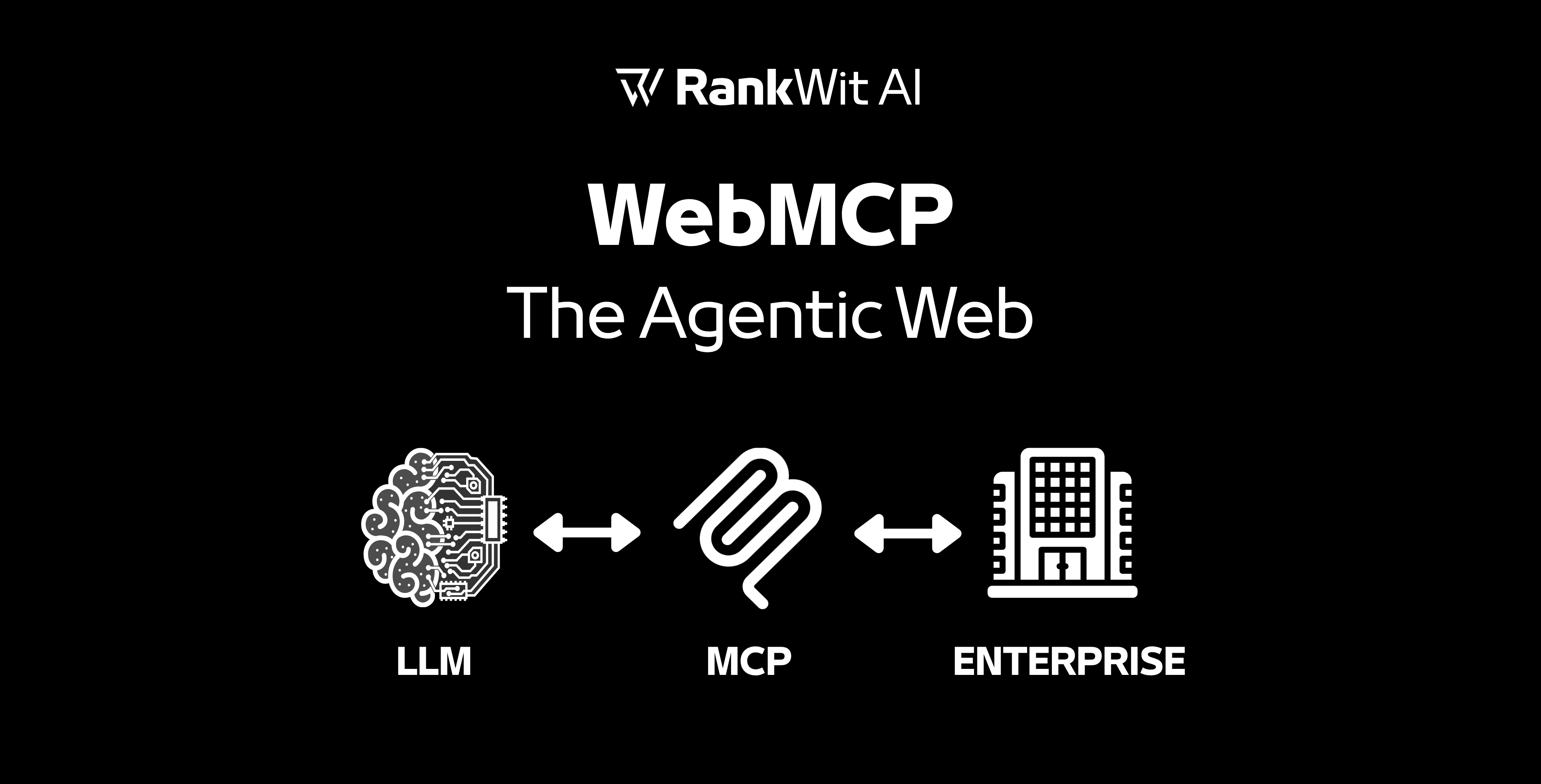
Traditional LLMs are limited by their training data "cutoff" dates. WebMCP bridges this gap by enabling Dynamic Context Injection:

  • The model identifies it needs live data (e.g., "What is the current inventory of Product X?").
  • It uses the WebMCP bidirectional channel to query the server.
  • The server returns structured data, which the AI then uses to generate an accurate, up-to-the-minute response.

Read More
ArrowArrow right blue
What’s the difference between GEO and AEO?
Arrow

Generative Engine Optimization (GEO) and Answer Engine Optimization (AEO) are closely related strategies, but they serve different purposes in how content is discovered and used by AI technologies.

  • AEO is focused on helping your content become the direct answer to user queries in AI-powered answer engines like Google's SGE (Search Generative Experience), Bing, or voice assistants. It emphasizes clear formatting, Q&A structure, and schema markup so that AI systems can easily extract and present your content in snippets or spoken responses.
  • GEO, on the other hand, is a broader approach designed to ensure your content is used, synthesized, or cited by generative AI models like ChatGPT, Gemini, Claude, and Perplexity. It involves creating high-quality, authoritative content that large language models (LLMs) recognize as trustworthy and relevant. It may also include using metadata tools (like llms.txt) to guide how AI systems interpret and prioritize your content.
In short:
AEO helps you be the answer in AI search results. GEO helps you be the source that generative AI platforms trust and cite.

Together, these strategies are essential for maximizing visibility in an AI-first search landscape.

Read More
ArrowArrow right blue
How do you measure AI visibility?
Arrow

We run your target prompts across every major AI platform, weekly, and track exactly where and how your hotel is mentioned.

You get a live dashboard showing your AI Share of Voice versus competitors, citation trends, and which prompts are sending you bookings.

Read More
ArrowArrow right blue
What are large language models and how do they enable artificial intelligence systems to understand and generate human language?
Arrow

Large language models (LLMs) are advanced artificial intelligence systems trained on large datasets of text to understand patterns in language. They can generate responses, summarize information, answer questions, and support many applications such as search, chatbots, and content creation.

Read More
ArrowArrow right blue
How are large language models used in modern search engines, digital platforms, and AI-powered applications?
Arrow

Large language models power many modern technologies, including AI assistants, conversational search systems, automated content generation, and customer support tools. Their ability to interpret natural language allows digital platforms to deliver more intelligent and interactive experiences.

Read More
ArrowArrow right blue

📚 Learn, Apply, Win

Stay inspired with the latest stories, tips, and insights.
Explore articles designed to spark ideas, share knowledge, and keep you updated on what’s new.