How do Large Language Models (LLMs) like ChatGPT actually work?

Large Language Models (LLMs) are AI systems trained on massive amounts of text data, from websites to books, to understand and generate language.

They use deep learning algorithms, specifically transformer architectures, to model the structure and meaning of language.

LLMs don't "know" facts in the way humans do. Instead, they predict the next word in a sequence using probabilities, based on the context of everything that came before it. This ability enables them to produce fluent and relevant responses across countless topics.

For a deeper look at the mechanics, check out our full blog post: How Large Language Models Work.

Last updated at  
April 13, 2026
Other FAQ
Who can benefit the most from using RankWit?
Arrow

RankWit is designed for anyone who wants to maximize their brand’s visibility on AI platforms. The main users include:

- Freelancers: Stand out by offering clients AI-optimized content services.
- Agencies: Add GEO to your service portfolio and stay ahead of competitors.
- Brands: Protect and expand your presence so that AI cites your company, not someone else’s.

Whether you work independently or as part of a larger marketing team, RankWit provides tools to monitor, optimize, and grow in the age of AI search.

Read More
ArrowArrow right blue
What key elements should be included when optimizing content for AI-driven search systems?
Arrow

Effective AI content optimization involves creating well-structured content with clear headings, strong topical relevance, and semantic connections between ideas. These elements help search engines and AI systems better interpret and rank content.

Read More
ArrowArrow right blue
Why is optimizing content for large language models becoming important for modern search visibility?
Arrow

Many modern search systems and AI assistants rely on large language models to generate responses. Optimizing content for LLMs increases the chances that information will be correctly interpreted and referenced in AI-generated answers.

Read More
ArrowArrow right blue
How does structured data help search engines and AI systems better understand the content and context of a website?
Arrow

Structured data uses standardized formats like schema markup to explain the meaning of your content to search engines. This allows platforms like Google and AI-powered search systems to better interpret your pages, connect them with relevant entities, and potentially display enhanced results such as rich snippets or knowledge panels.

Read More
ArrowArrow right blue
Why is academic and industry literature important for understanding developments in AI, search technologies, and digital marketing?
Arrow

Academic and industry literature offers valuable research, analysis, and expert perspectives on emerging technologies and digital strategies. Reviewing this literature helps professionals stay informed about innovations, methodologies, and best practices in AI and search optimization.

Read More
ArrowArrow right blue
What is ChatGPT Instant Checkout and how does it work for e-commerce merchants?
Arrow

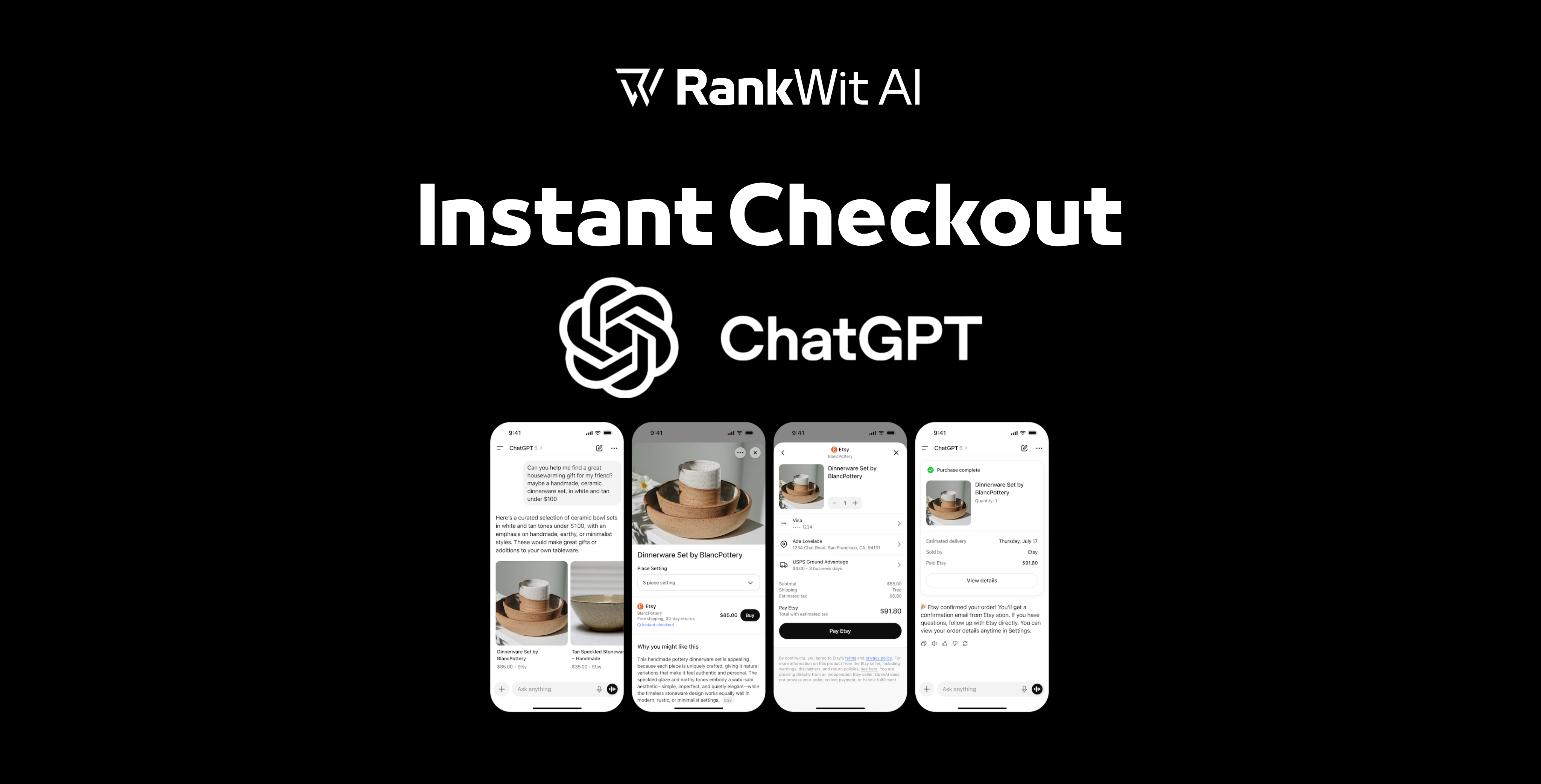
ChatGPT Instant Checkout is a new capability since 2025 developed by OpenAI that allows users to discover, configure, and purchase products directly within ChatGPT without leaving the conversation.
This functionality is powered by the Agentic Commerce Protocol (ACP), an open standard that defines how merchants’ systems interact with AI agents.

Merchants connect their product catalog through a structured product feed, expose checkout endpoints via the Agentic Checkout API, and process payments securely through delegated payment providers like Stripe.
Together, these layers create a smooth, conversational shopping experience that merges AI discovery with secure e-commerce execution.

Read More
ArrowArrow right blue
How should retailers and marketing professionals adapt their strategies to Google’s Generative AI Shopping features?
Arrow

Google's Generative AI Shopping features are redefining the journey from product discovery to purchase. For retailers and marketers, this demands a strategic shift across several areas.

Invest in Visual Quality

With AI-powered "Shop Similar" product matches based on visual and semantic similarity rather than keywords alone, product image quality has never mattered more. Low-resolution photos, inconsistent backgrounds, or images that don't accurately represent the product will be at a disadvantage.

Best practice: Use clean, high-resolution product photography. Make sure images accurately represent colors, textures, and proportions, as the AI matching engine evaluates these attributes directly.

Optimize Your Shopping Graph Presence

Google's Shopping Graph — a continuously updated dataset of over 35 billion product listings — is the backbone of every AI-powered shopping feature. Incomplete, outdated, or missing products simply won't surface in AI-generated results.

Best practice: Keep product feeds up to date with accurate titles, descriptions, prices, availability, and structured attributes. Treat Shopping Graph as critical infrastructure, not a secondary operation.

Prepare for Conversational Queries

As users learn to describe products in natural language (e.g., "gifts for a 7-year-old who wants to be an inventor"), search behavior will shift toward longer, more descriptive queries. These are exactly the kind of queries generative AI excels at interpreting.

Best practice: Write product descriptions and category content that mirrors how real people talk about your products. Focus on use cases, scenarios, and specific attributes rather than generic marketing copy.

Monitor AI-Referred Traffic

According to Adobe Analytics, traffic from generative AI tools to retail websites grew 1,200% year over year in early 2025, with visitors showing longer sessions, more page views, and lower bounce rates. While still a small share of total traffic, the growth trajectory is steep.

Best practice: Track AI-referred traffic as a distinct channel in your analytics. Identify which products and categories are being surfaced by AI tools and optimize accordingly.

The shift from keyword search to AI-powered generative search is not a future event, it's happening now. Retailers who adapt their product data, visual assets, and content strategy today will be positioned to capture the growing share of purchase intent driven by AI-powered discovery.

Read More
ArrowArrow right blue
What kind of optimization recommendations does RankWit provide?
Arrow

RankWit analyzes your existing content and gives actionable, data-backed recommendations for improving your AI visibility. Suggestions include:

  • Rewriting sentences to be more concise and AI-parsable
  • Restructuring content into formats AI engines prefer (e.g., lists, FAQs, summaries)
  • Highlighting authority signals, such as including stats, sources, or clear claims
    These optimizations are designed to increase the chances that AI platforms surface your content over competitors’.

Read More
ArrowArrow right blue
Will GEO replace SEO in how businesses get discovered online
Arrow

GEO is not a replacement for SEO—it’s an evolution of how users interact with information online.

While SEO (Search Engine Optimization) focuses on ranking content in traditional search engines like Google, GEO (Generative Engine Optimization) focuses on making content discoverable and useful within AI-powered search and assistant experiences.

Here’s how they differ and work together:

  • SEO drives visibility on web search engines. It optimizes for keywords, backlinks, and structured content to help pages rank high.
  • GEO optimizes for AI discovery. It ensures your content is easily understood, retrieved, and accurately cited by AI tools like ChatGPT, Perplexity, or Claude.

As AI assistants increasingly become the first touchpoint for information retrieval, GEO is becoming essential. But SEO is still critical for attracting traffic from search engines and building long-term domain authority.

In short: GEO enhances your content’s AI-readiness, while SEO ensures it’s search-engine-ready. The future is not SEO or GEO—it’s SEO and GEO, working in tandem.

Read More
ArrowArrow right blue
Does RankWit support multiple countries?
Arrow

Yes! RankWit includes unlimited country tracking across all plans at no additional cost.
You can monitor AI visibility for any market worldwide.

Read More
ArrowArrow right blue

📚 Learn, Apply, Win

Stay inspired with the latest stories, tips, and insights.
Explore articles designed to spark ideas, share knowledge, and keep you updated on what’s new.