How does structured data help search engines and AI systems better understand the content and context of a website?

Structured data uses standardized formats like schema markup to explain the meaning of your content to search engines. This allows platforms like Google and AI-powered search systems to better interpret your pages, connect them with relevant entities, and potentially display enhanced results such as rich snippets or knowledge panels.

Last updated at  
April 13, 2026
Other FAQ
How does RankWit.ai handle Brand Mentions to help monitor and optimize my brand presence across the web, and what steps are involved in tracking, prioritizing, and acting on mentions to improve SEO and reputation?
Arrow

**Brand Mentions that drive action.** RankWit.ai continuously monitors the web for mentions of your brand, products, and campaigns across sources like news, blogs, forums, and social media. Each mention is analyzed for sentiment, authority, and relevance, so you can see not just where you’re discussed, but how it affects SEO and brand health.

**What you get:**
- **Real-time detection** of new mentions across a broad publisher set.
- **Sentiment and context** analysis to understand tone and potential risk or opportunity.
- **Impact ranking** that prioritizes high-value mentions by engagement potential, source credibility, and audience size.
- **Topic enrichment** to surface related keywords and content angles for optimization.
- **Alerts and digests** so you stay informed without noise.

**How to use Brand Mentions effectively**
1. **Set your brand and product keywords** to ensure comprehensive coverage.
2. **Filter by sentiment, platform, and authority** to focus on the signals that matter most.
3. **Action directly from the platform**: draft outreach, respond to feedback, or create content based on real conversations.
4. **Leverage insights for SEO**: identify backlink opportunities and topical gaps to strengthen content strategy.
5. **Track trends over time** to spot seasonal spikes and measure the impact of campaigns.

**Workflow quick-start**: enable Brand Mentions, configure keywords, set thresholds, and connect to your CRM or CMS for rapid response. For a guided tour, visit our [Try it now](/features) page and see Brand Mentions in action.

Read More
ArrowArrow right blue
Why is understanding user intent essential for creating content that performs well in modern search engines?
Arrow

Understanding user intent allows businesses to create content that directly answers user questions and needs. When content aligns with search intent, search engines are more likely to consider it relevant and display it in search results.

Read More
ArrowArrow right blue
What insights can industry case studies provide about the impact of AI on search visibility and digital marketing?
Arrow

Industry case studies highlight how AI technologies influence search rankings, content visibility, and user engagement. They demonstrate how companies adapt their strategies to new search technologies and provide measurable insights into the impact of AI-driven optimization.

Read More
ArrowArrow right blue
How can companies use business cases to justify investments in AI-driven search and digital optimization?
Arrow

Businesses use business cases to evaluate the potential impact of adopting AI technologies and search optimization strategies. By analyzing costs, expected improvements, and measurable results, companies can make informed decisions about implementing new digital initiatives.

Read More
ArrowArrow right blue
Why is a well-defined content strategy important for visibility in AI-powered search engines?
Arrow

A strong content strategy helps establish authority within a specific topic area. When content consistently covers relevant subjects with clear structure and reliable information, AI systems are more likely to recognize the source as trustworthy.

Read More
ArrowArrow right blue
What is AI Search Optimization and why is it important?
Arrow

AI Search Optimization refers to the practice of structuring, formatting, and presenting digital content to ensure it is surfaced by AI systems—particularly large language models (LLMs)—in response to user queries.Choosing a clear, unified name for this emerging field is crucial because it shapes professional standards, guides tool development, informs marketing strategies, and fosters a cohesive community of practice. Without a consistent term, the industry risks fragmentation and inefficiency, much like early digital marketing faced before "SEO" was widely adopted.

Read More
ArrowArrow right blue
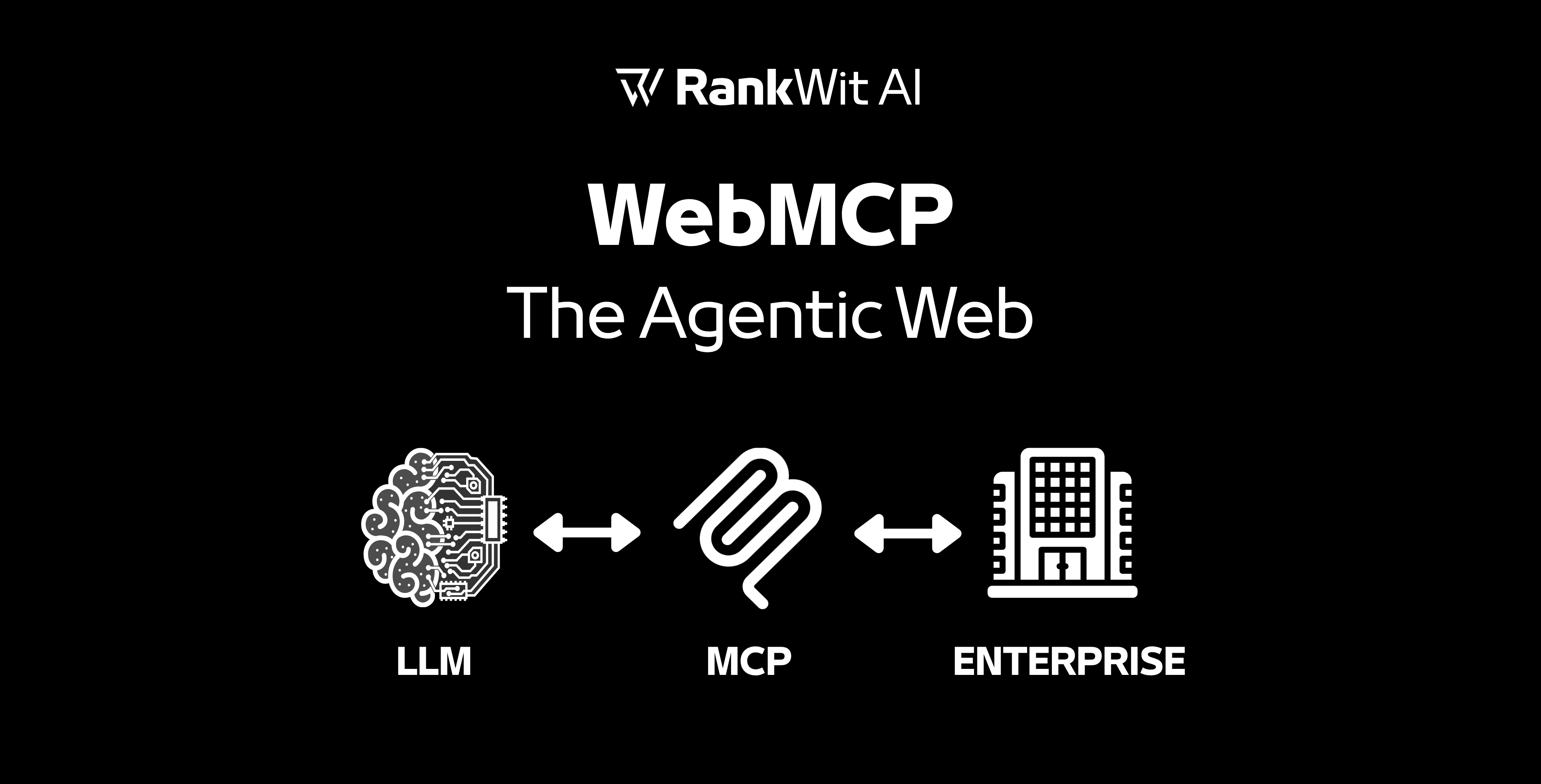
Is it difficult for developers to implement WebMCP on an existing website or application?
Arrow

Implementing WebMCP is streamlined through the Google Chrome Labs toolkit. Developers have two primary paths:

  • Declarative: Simply add toolname and tooldescription attributes to existing HTML <form> tags.
  • Imperative: Use the navigator.modelContext.registerTool() API to expose complex JavaScript functions as callable AI tools.This flexibility allows teams to start with basic functionality and scale to complex integrations without a total architecture overhaul.

Read More
ArrowArrow right blue
Do I need to replace my existing marketing agency?
Arrow

No. RankWit works alongside your current team, whether in-house or agency.
We handle the AI visibility layer that traditional partners aren't equipped for, and we share everything we do so your team stays in full control.

Read More
ArrowArrow right blue
Will GEO replace SEO in how businesses get discovered online
Arrow

GEO is not a replacement for SEO—it’s an evolution of how users interact with information online.

While SEO (Search Engine Optimization) focuses on ranking content in traditional search engines like Google, GEO (Generative Engine Optimization) focuses on making content discoverable and useful within AI-powered search and assistant experiences.

Here’s how they differ and work together:

  • SEO drives visibility on web search engines. It optimizes for keywords, backlinks, and structured content to help pages rank high.
  • GEO optimizes for AI discovery. It ensures your content is easily understood, retrieved, and accurately cited by AI tools like ChatGPT, Perplexity, or Claude.

As AI assistants increasingly become the first touchpoint for information retrieval, GEO is becoming essential. But SEO is still critical for attracting traffic from search engines and building long-term domain authority.

In short: GEO enhances your content’s AI-readiness, while SEO ensures it’s search-engine-ready. The future is not SEO or GEO—it’s SEO and GEO, working in tandem.

Read More
ArrowArrow right blue
What key elements should be included when optimizing content for AI-driven search systems?
Arrow

Effective AI content optimization involves creating well-structured content with clear headings, strong topical relevance, and semantic connections between ideas. These elements help search engines and AI systems better interpret and rank content.

Read More
ArrowArrow right blue

📚 Learn, Apply, Win

Stay inspired with the latest stories, tips, and insights.
Explore articles designed to spark ideas, share knowledge, and keep you updated on what’s new.