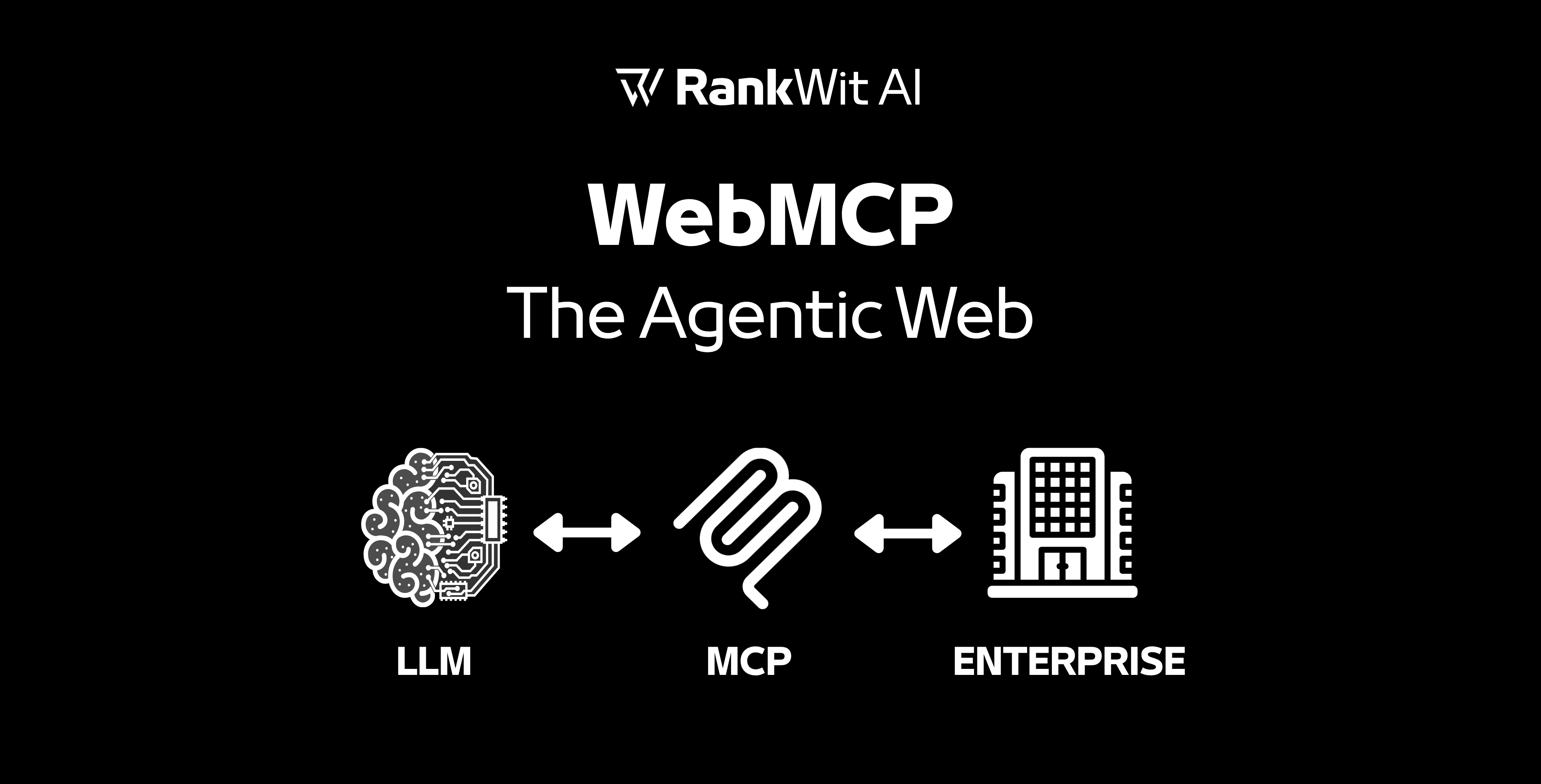
What does the term "Agentic Web" mean in the context of WebMCP technology?

We are moving from a web of pixels to a web of actions.

  • Current Web: Users click, scroll, and read to finish a task.
  • Agentic Web (via WebMCP): A user gives a goal (e.g., "Find and book a flight under $400 for next Tuesday"), and the AI orchestrates the necessary steps across different sites using their exposed WebMCP tools.WebMCP provides the standardized language that allows these agents to navigate different platforms with the same ease a human would, but with the speed of an API.

Last updated at  
April 13, 2026
Other FAQ
What are model optimization techniques and why are they important for improving the performance of AI systems and language models?
Arrow

Model optimization techniques are strategies used to improve the performance, speed, and efficiency of artificial intelligence models. These techniques help AI systems process information more accurately while reducing computational costs and improving scalability.

Read More
ArrowArrow right blue
What strategies can businesses use to strengthen their authority signals for AI-powered search systems?
Arrow

Businesses can strengthen their AI authority by earning media coverage, publishing expert content, building high-quality backlinks, and maintaining consistent brand mentions across trusted platforms. These signals help AI systems identify the brand as a reliable source within its industry.

Read More
ArrowArrow right blue
Why is it important for websites to adapt their SEO strategies to prepare for the future of AI-driven search engines?
Arrow

As search engines integrate AI technologies, ranking factors are shifting toward content quality, semantic relevance, structured data, and entity relationships. Websites that adapt their SEO strategies to these changes are more likely to remain visible in future search environments.

Read More
ArrowArrow right blue
What is Google's Generative AI Shopping, and how does it change the way people search for products?
Arrow

Google's Generative AI Shopping is a set of capabilities within Google's Search Generative Experience (SGE) that transforms product discovery from a keyword-based process into a visual, conversational one.

Instead of scrolling through pages of blue links, users can now:

  • Describe what they want in plain language (e.g., "colorful metallic puffer jacket") and receive AI-generated photorealistic images that match their description.
  • Refine results conversationally, adjusting details like color, pattern, or style with follow-up prompts.
  • Browse shoppable products that visually match the generated images, pulled directly from Google's Shopping Graph, a dataset of over 35 billion product listings updated in real time.

This approach is particularly powerful for apparel and fashion, where traditional keyword search often fails to capture the specificity of what a shopper has in mind. According to Google's internal data, 20% of apparel queries are five words or longer, a type of search that generative AI handles far more effectively than conventional engines.

Why it matters for GEO: Content and product listings that are well-structured, semantically rich, and paired with high-quality imagery are more likely to be surfaced in these AI-generated shopping results. Optimizing for this new discovery layer is now a core part of any AI visibility strategy.

Read More
ArrowArrow right blue
Why are large language models becoming an important part of modern search engine technologies?
Arrow

LLMs enable search engines to process complex questions, identify relationships between topics, and provide more detailed responses. This technology is helping search platforms move toward more conversational and intelligent search experiences.

Read More
ArrowArrow right blue
Will GEO replace SEO in how businesses get discovered online
Arrow

GEO is not a replacement for SEO—it’s an evolution of how users interact with information online.

While SEO (Search Engine Optimization) focuses on ranking content in traditional search engines like Google, GEO (Generative Engine Optimization) focuses on making content discoverable and useful within AI-powered search and assistant experiences.

Here’s how they differ and work together:

  • SEO drives visibility on web search engines. It optimizes for keywords, backlinks, and structured content to help pages rank high.
  • GEO optimizes for AI discovery. It ensures your content is easily understood, retrieved, and accurately cited by AI tools like ChatGPT, Perplexity, or Claude.

As AI assistants increasingly become the first touchpoint for information retrieval, GEO is becoming essential. But SEO is still critical for attracting traffic from search engines and building long-term domain authority.

In short: GEO enhances your content’s AI-readiness, while SEO ensures it’s search-engine-ready. The future is not SEO or GEO—it’s SEO and GEO, working in tandem.

Read More
ArrowArrow right blue
What is ChatGPT Shopping Research and how does it work?
Arrow

Shopping Research is a feature in ChatGPT that acts as a personalized shopping assistant.
Simply describe what you’re looking for, such as “a lightweight laptop for travel”, and ChatGPT gathers product details, reviews, specs, prices, and comparisons from the web.

You can refine the results by marking products as “Not interested” or “More like this”, helping ChatGPT understand your preferences.

At the end, you receive a custom buyer’s guide that explains the pros, cons, and trade-offs of each option, making your purchase process easier and more informed.

Read More
ArrowArrow right blue
Who can benefit the most from using RankWit?
Arrow

RankWit is designed for anyone who wants to maximize their brand’s visibility on AI platforms. The main users include:

- Freelancers: Stand out by offering clients AI-optimized content services.
- Agencies: Add GEO to your service portfolio and stay ahead of competitors.
- Brands: Protect and expand your presence so that AI cites your company, not someone else’s.

Whether you work independently or as part of a larger marketing team, RankWit provides tools to monitor, optimize, and grow in the age of AI search.

Read More
ArrowArrow right blue
When will we start seeing the first results for our destinations?
Arrow

Most tourism organizations see measurable improvements in AI citations and recommendations within 30–60 days.

Full and cumulative results typically emerge between 90 and 180 days, depending on the initial positioning of the territories and the complexity of the target tourism markets.

Read More
ArrowArrow right blue
What are large language models and how do they enable artificial intelligence systems to understand and generate human language?
Arrow

Large language models (LLMs) are advanced artificial intelligence systems trained on large datasets of text to understand patterns in language. They can generate responses, summarize information, answer questions, and support many applications such as search, chatbots, and content creation.

Read More
ArrowArrow right blue

📚 Learn, Apply, Win

Stay inspired with the latest stories, tips, and insights.
Explore articles designed to spark ideas, share knowledge, and keep you updated on what’s new.