What strategies can businesses use to strengthen their authority signals for AI-powered search systems?

Businesses can strengthen their AI authority by earning media coverage, publishing expert content, building high-quality backlinks, and maintaining consistent brand mentions across trusted platforms. These signals help AI systems identify the brand as a reliable source within its industry.

Last updated at  
April 13, 2026
Other FAQ
What types of metrics are most useful for evaluating performance in AI-driven search environments?
Arrow

AI search performance metrics are the new frontier for digital marketers. As generative engines like Gemini and Search Generative Experience (SGE) redefine how users find information, relying solely on legacy SEO tracking is no longer enough. To succeed, you must measure how AI models perceive, rank, and cite your content.

1. Subjective ImpressionThis metric evaluates how well your content answers user queries compared to competitors. AI models assess the relevance, completeness, and accuracy of your content. A high score signifies that your content provides comprehensive answers that LLMs deem most helpful to the user.

2. Position ScoreSimilar to traditional SERP rankings, the Position Score measures how high your website ranks within the AI’s generated response. Calculated by your average ranking position (1st, 2nd, 3rd), a higher position directly correlates with increased user trust and higher click-through potential from AI citations.

3. Share of Voice (SoV)In the context of GEO, Share of Voice measures the percentage of queries where your website is mentioned or cited in the AI's response. A dominant SoV indicates broad topical authority and ensures your brand remains "top of mind" for the AI across various related search strings.

4. Consistency ScoreBecause users interact with various models (Perplexity, ChatGPT, Gemini), the Consistency Score is vital. It tracks the similarity of your rankings and mentions across multiple platforms. High consistency ensures that your brand’s authority is recognized universally, regardless of the specific AI model used.

Read More
ArrowArrow right blue
What types of literature are most useful for professionals working with AI-driven search and digital optimization?
Arrow

Professionals working with AI-driven search benefit from reviewing academic studies, technical papers, and industry reports. These sources provide evidence-based insights that help explain how search technologies evolve and how optimization strategies should adapt.

Read More
ArrowArrow right blue
How is artificial intelligence transforming the future of search engines and the way users discover information online?
Arrow

Artificial intelligence is transforming search from simple keyword matching to understanding intent, context, and relationships between topics. AI-powered systems can generate answers, summarize information, and connect multiple sources, changing how users discover and interact with content online.

Read More
ArrowArrow right blue
What’s RAG (Retrieval-Augmented Generation), and why is it critical for GEO?
Arrow

RAG (Retrieval-Augmented Generation) is a cutting-edge AI technique that enhances traditional language models by integrating an external search or knowledge retrieval system. Instead of relying solely on pre-trained data, a RAG-enabled model can search a database or knowledge source in real time and use the results to generate more accurate, contextually relevant answers.

For GEO, this is a game changer.
GEO doesn't just respond with generic language—it retrieves fresh, relevant insights from your company’s knowledge base, documents, or external web content before generating its reply. This means:

  • More accurate and grounded answers
  • Up-to-date responses, even in dynamic environments
  • Context-aware replies tied to your data and terminology

By combining the strengths of generation and retrieval, RAG ensures GEO doesn't just sound smart—it is smart, aligned with your source of truth.

Read More
ArrowArrow right blue
Does ChatGPT share my personal data with retailers when using Shopping Research?
Arrow

Your privacy remains a priority when using Shopping Research.
ChatGPT does not send your personal information, queries, or preferences to retailers or third-party sites.

The tool simply gathers publicly available product information online, such as specifications, reviews, and prices, and organizes it into a personalized buyer’s guide for you.

You stay in full control, and no personal data is exchanged during the process.

Read More
ArrowArrow right blue
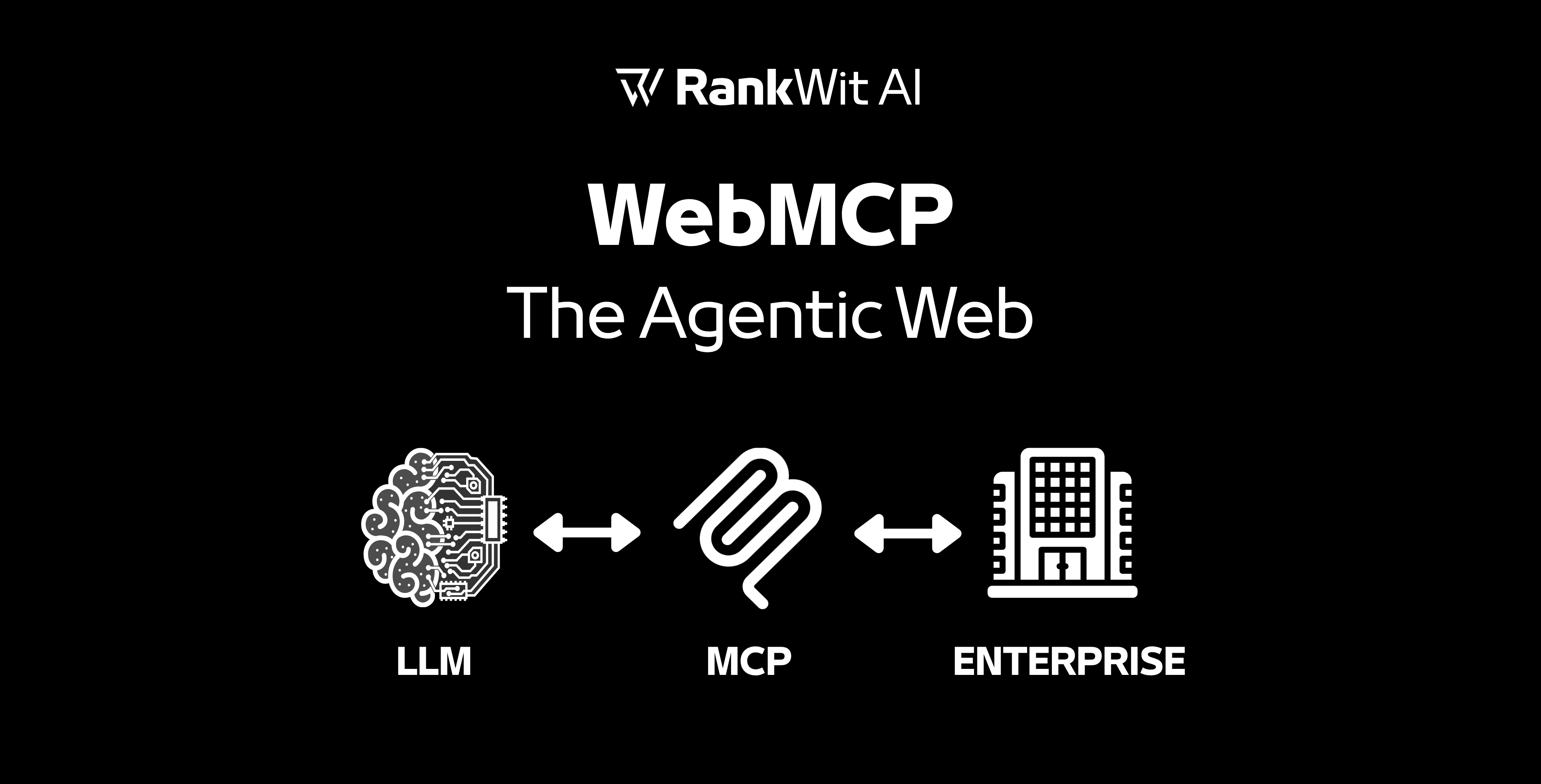
How does WebMCP differ from traditional web scraping when AI agents interact with websites?
Arrow

While traditional scraping is fragile and prone to breaking when a website's design changes, WebMCP provides a reliable "handshake" between the site and the AI.

  • Direct Access: Agents call specific functions (tools) instead of searching for buttons in code.
  • Resilience: Site layout changes don't break the integration as long as the underlying WebMCP schema remains the same.
  • Efficiency: It significantly reduces the tokens and compute power needed for an AI to "understand" a page

Read More
ArrowArrow right blue
Why is it important for local businesses to optimize their online presence for AI-driven local search platforms?
Arrow

As search engines increasingly rely on AI, local businesses must ensure their data is accurate, structured, and consistent across platforms. Optimizing business profiles, location information, and local content helps AI systems better understand and recommend businesses to nearby users

Read More
ArrowArrow right blue
Why does GEO matter now?
Arrow

Generative Engine Optimization (GEO) is becoming increasingly critical as user behavior shifts toward AI-native search tools like ChatGPT, Gemini, and Perplexity.
According with Bain, recent data shows that over 40% of users now prefer AI-generated answers over traditional search engine results.
This trend reflects a major evolution in how people discover and consume information.

Unlike traditional SEO, which focuses on ranking in static search results, GEO ensures that your content is understandable, relevant, and authoritative enough to be cited or surfaced in LLM-generated responses.
This is especially important as AI platforms begin to integrate live web search capabilities, summaries, and citations directly into their answers.

The urgency is amplified by user traffic trends. According to Similarweb data (see chart below), ChatGPT visits are projected to surpass Google’s by December 2026 if current growth continues.
This suggests that visibility in LLMs may soon be as important—if not more—than traditional search rankings.

Projection based on traffic from the last 6 months (source: Similarweb US).

Read More
ArrowArrow right blue
How will large language model optimization evolve as AI-powered search engines and generative systems continue to advance?
Arrow

As AI systems continue to evolve, LLM optimization will increasingly prioritize clear information structure, entity relationships, and trustworthy sources. Content that provides accurate, well-organized knowledge will be more likely to be interpreted and referenced by future AI models.

Read More
ArrowArrow right blue
Can we continue working with our communication agency or our internal team?
Arrow

Of course. RankWit works alongside your current team, whether internal or external. We manage the visibility layer on AI platforms (AIO), which traditional marketing agencies are not yet equipped to cover. We share every data point and action taken so that the organization maintains full strategic control over the territory’s narrative.

Read More
ArrowArrow right blue

📚 Learn, Apply, Win

Stay inspired with the latest stories, tips, and insights.
Explore articles designed to spark ideas, share knowledge, and keep you updated on what’s new.