How does WebMCP differ from traditional web scraping when AI agents interact with websites?

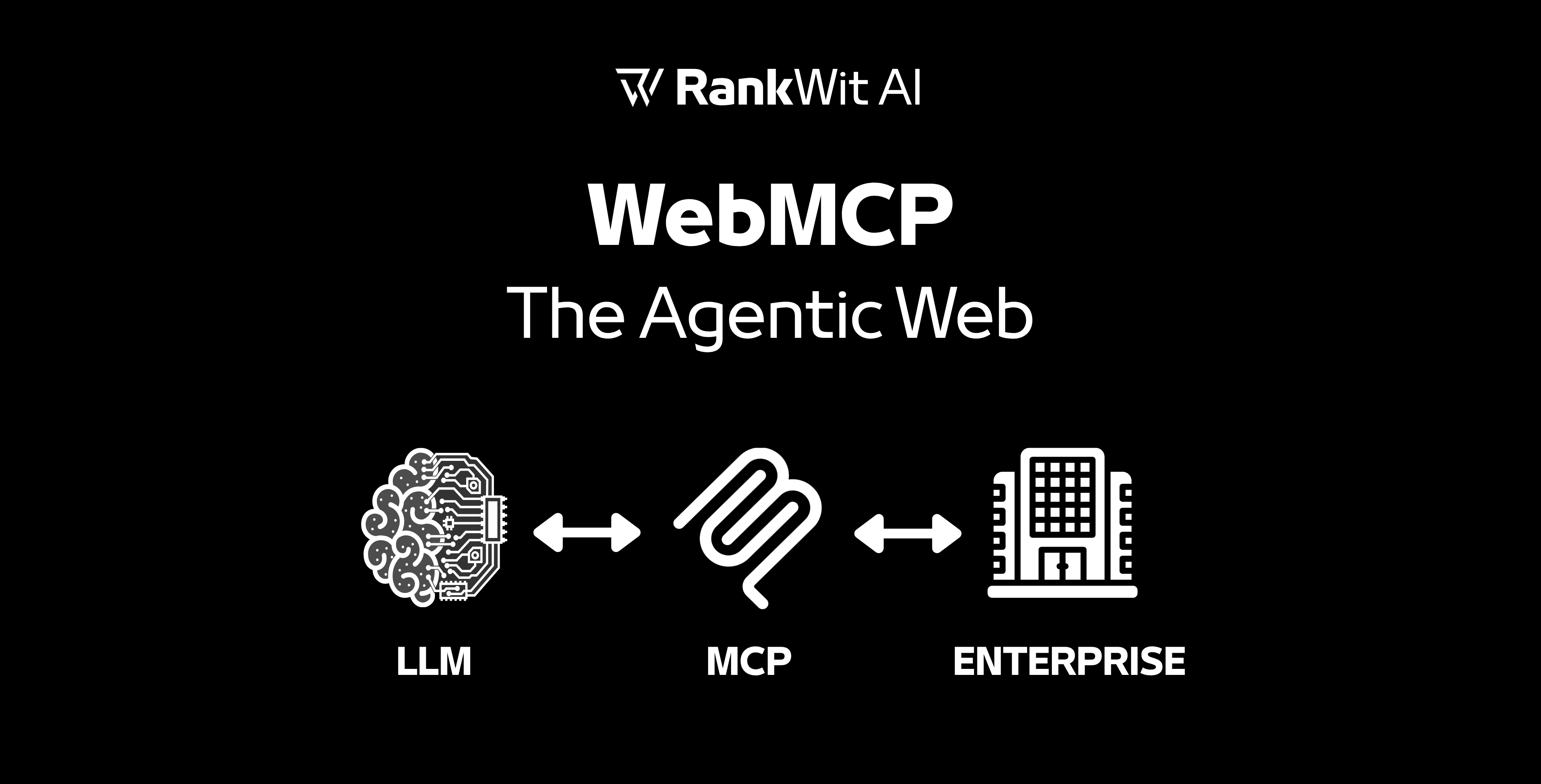
While traditional scraping is fragile and prone to breaking when a website's design changes, WebMCP provides a reliable "handshake" between the site and the AI.

  • Direct Access: Agents call specific functions (tools) instead of searching for buttons in code.
  • Resilience: Site layout changes don't break the integration as long as the underlying WebMCP schema remains the same.
  • Efficiency: It significantly reduces the tokens and compute power needed for an AI to "understand" a page

Last updated at  
April 13, 2026
Other FAQ
Which plan should I choose: Starter, Growth, or Enterprise?
Arrow

RankWit plans are designed to scale with your needs:

  • Starter: Best for freelancers, consultants, and small agencies beginning with AI visibility tracking.
  • Growth: Great for established agencies, marketing teams, and organizations with multiple websites.
  • Enterprise: Built for large companies needing advanced customization, higher credit volumes, and dedicated support.

If you’re unsure, we can help you select the best plan based on your tracking volume and team size.

Read More
ArrowArrow right blue
How are LLMs trained to understand and generate human-like text?
Arrow

Training a Large Language Model involves feeding it enormous volumes of text data, from books and blogs to academic papers and web content.

This data is tokenized (split into smaller parts like words or subwords), and then processed through multiple layers of a deep learning model.

Over time, the model learns statistical relationships between words and phrases. For example, it learns that “coffee” often appears near “morning” or “caffeine.” These associations help the model generate text that feels intuitive and human.

Once the base training is done, models are often fine-tuned using additional data and human feedback to improve accuracy, tone, and usefulness. The result: a powerful tool that understands language well enough to assist with everything from SEO optimization to natural conversation.

Read More
ArrowArrow right blue
How is artificial intelligence transforming the future of search engines and the way users discover information online?
Arrow

Artificial intelligence is transforming search from simple keyword matching to understanding intent, context, and relationships between topics. AI-powered systems can generate answers, summarize information, and connect multiple sources, changing how users discover and interact with content online.

Read More
ArrowArrow right blue
Can I cancel my subscription at any time?
Arrow

Yes. You can cancel your subscription, downgrade, or upgrade your plan at any time.

Read More
ArrowArrow right blue
How does digital PR help build brand authority and improve visibility in AI-powered search engines?
Arrow

Digital PR helps brands gain mentions, links, and coverage from reputable websites and publications. These signals strengthen brand authority and help search engines and AI systems recognize a company as a trusted source of information.

Read More
ArrowArrow right blue
What role does WebMCP play in Retrieval-Augmented Generation (RAG) and real-time search?
Arrow

Traditional LLMs are limited by their training data "cutoff" dates. WebMCP bridges this gap by enabling Dynamic Context Injection:

  • The model identifies it needs live data (e.g., "What is the current inventory of Product X?").
  • It uses the WebMCP bidirectional channel to query the server.
  • The server returns structured data, which the AI then uses to generate an accurate, up-to-the-minute response.

Read More
ArrowArrow right blue
How is GEO different from SEO?
Arrow

GEO (Generative Engine Optimization) is not a rebrand of SEO—it’s a response to an entirely new environment. SEO optimizes for bots that crawl, index, and rank. GEO optimizes for large language models (LLMs) that read, learn, and generate human-like answers.

While SEO is built around keywords and backlinks, GEO is about semantic clarity, contextual authority, and conversational structuring. You're not trying to please an algorithm—you’re helping an AI understand and echo your ideas accurately in its responses. It's not just about being found—it's about being spoken for.

Read More
ArrowArrow right blue
What happens during a free AI audit?
Arrow

We test how ChatGPT, Gemini, and Perplexity currently respond when travelers ask about your destination, category, and competitors.

You receive a full report showing where you're visible, where you're missing, and the specific prompts losing you bookings today. No commitment required.

Read More
ArrowArrow right blue
What trends will shape the next generation of LLM optimization strategies?
Arrow

Future LLM optimization strategies will focus on semantic understanding, strong entity signals, structured knowledge, and high-quality information sources. These trends will help AI systems deliver more accurate and context-aware responses.

Read More
ArrowArrow right blue
Can we continue working with our communication agency or our internal team?
Arrow

Of course. RankWit works alongside your current team, whether internal or external. We manage the visibility layer on AI platforms (AIO), which traditional marketing agencies are not yet equipped to cover. We share every data point and action taken so that the organization maintains full strategic control over the territory’s narrative.

Read More
ArrowArrow right blue

📚 Learn, Apply, Win

Stay inspired with the latest stories, tips, and insights.
Explore articles designed to spark ideas, share knowledge, and keep you updated on what’s new.