📚 Learn, Apply, Win
Explore articles designed to spark ideas, share knowledge, and keep you updated on what’s new.
Search intent is commonly divided into informational, navigational, commercial, and transactional categories. Recognizing these intent types helps businesses design content that aligns with user goals, improving visibility and engagement in search results.
Google's Generative AI Shopping is a set of capabilities within Google's Search Generative Experience (SGE) that transforms product discovery from a keyword-based process into a visual, conversational one.
Instead of scrolling through pages of blue links, users can now:
This approach is particularly powerful for apparel and fashion, where traditional keyword search often fails to capture the specificity of what a shopper has in mind. According to Google's internal data, 20% of apparel queries are five words or longer, a type of search that generative AI handles far more effectively than conventional engines.
Why it matters for GEO: Content and product listings that are well-structured, semantically rich, and paired with high-quality imagery are more likely to be surfaced in these AI-generated shopping results. Optimizing for this new discovery layer is now a core part of any AI visibility strategy.
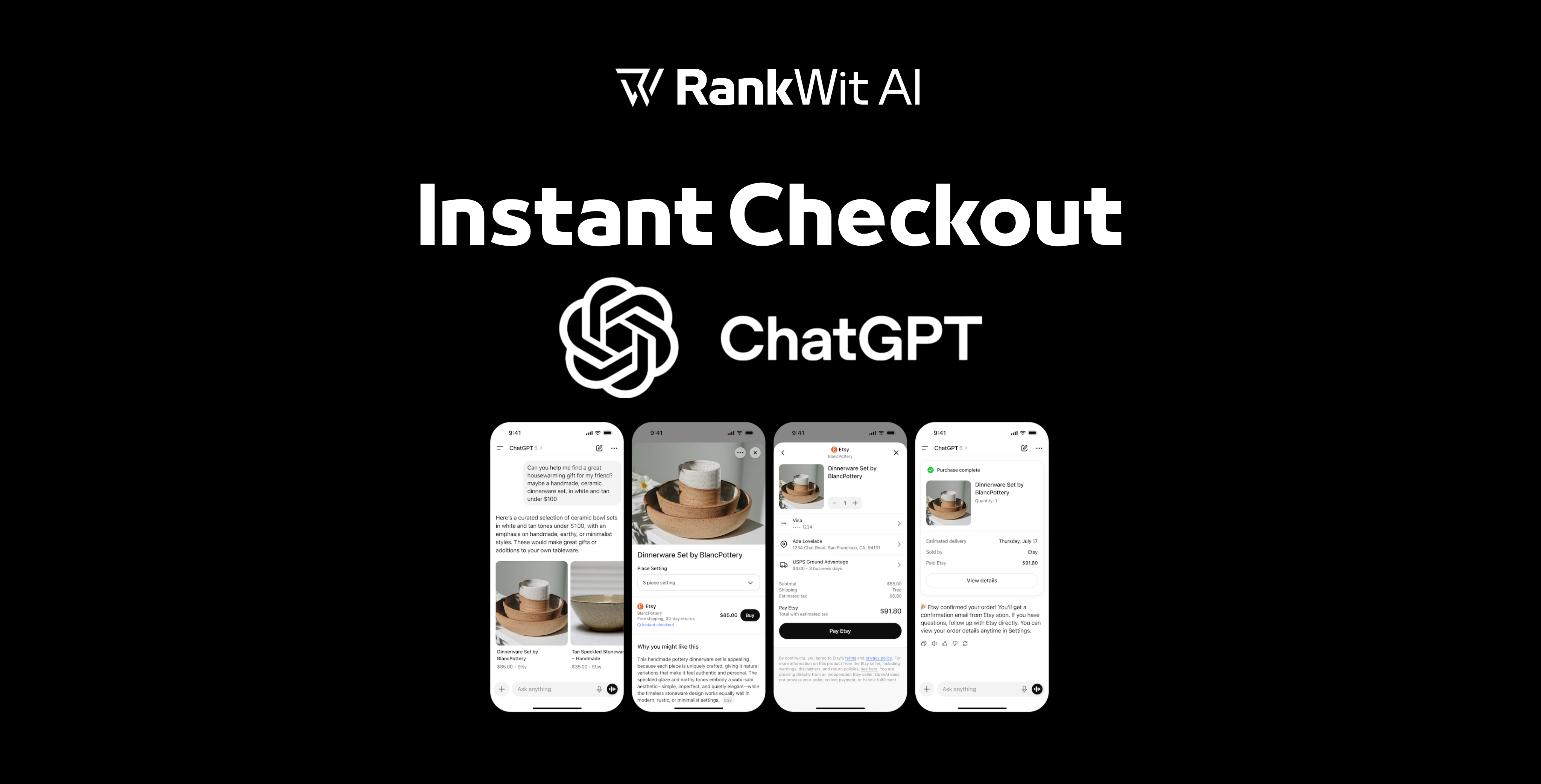
ChatGPT Instant Checkout is a new capability since 2025 developed by OpenAI that allows users to discover, configure, and purchase products directly within ChatGPT without leaving the conversation.
This functionality is powered by the Agentic Commerce Protocol (ACP), an open standard that defines how merchants’ systems interact with AI agents.
Merchants connect their product catalog through a structured product feed, expose checkout endpoints via the Agentic Checkout API, and process payments securely through delegated payment providers like Stripe.
Together, these layers create a smooth, conversational shopping experience that merges AI discovery with secure e-commerce execution.
This is the core objective. Travelers who discover a destination through AI recommendations arrive on institutional portals or local operator websites with very strong travel intent.
Properly positioning the territory within AI means capturing demand before competitors, reducing dependence on third-party distribution channels, and enhancing the entire local economic ecosystem.
Training a Large Language Model involves feeding it enormous volumes of text data, from books and blogs to academic papers and web content.
This data is tokenized (split into smaller parts like words or subwords), and then processed through multiple layers of a deep learning model.
Over time, the model learns statistical relationships between words and phrases. For example, it learns that “coffee” often appears near “morning” or “caffeine.” These associations help the model generate text that feels intuitive and human.
Once the base training is done, models are often fine-tuned using additional data and human feedback to improve accuracy, tone, and usefulness. The result: a powerful tool that understands language well enough to assist with everything from SEO optimization to natural conversation.
RankWit analyzes your existing content and gives actionable, data-backed recommendations for improving your AI visibility. Suggestions include:
GEO (Generative Engine Optimization) is not a rebrand of SEO—it’s a response to an entirely new environment. SEO optimizes for bots that crawl, index, and rank. GEO optimizes for large language models (LLMs) that read, learn, and generate human-like answers.
While SEO is built around keywords and backlinks, GEO is about semantic clarity, contextual authority, and conversational structuring. You're not trying to please an algorithm—you’re helping an AI understand and echo your ideas accurately in its responses. It's not just about being found—it's about being spoken for.