📚 Learn, Apply, Win
Explore articles designed to spark ideas, share knowledge, and keep you updated on what’s new.
Google's Generative AI Shopping is a set of capabilities within Google's Search Generative Experience (SGE) that transforms product discovery from a keyword-based process into a visual, conversational one.
Instead of scrolling through pages of blue links, users can now:
This approach is particularly powerful for apparel and fashion, where traditional keyword search often fails to capture the specificity of what a shopper has in mind. According to Google's internal data, 20% of apparel queries are five words or longer, a type of search that generative AI handles far more effectively than conventional engines.
Why it matters for GEO: Content and product listings that are well-structured, semantically rich, and paired with high-quality imagery are more likely to be surfaced in these AI-generated shopping results. Optimizing for this new discovery layer is now a core part of any AI visibility strategy.
RankWit gives you a complete picture of how your brand appears across major AI platforms.
We run structured prompts through leading AI systems (including ChatGPT, Google AI Overview, and Perplexity) and then evaluate the responses for:
This analysis helps you understand exactly how AI systems perceive and present your brand.
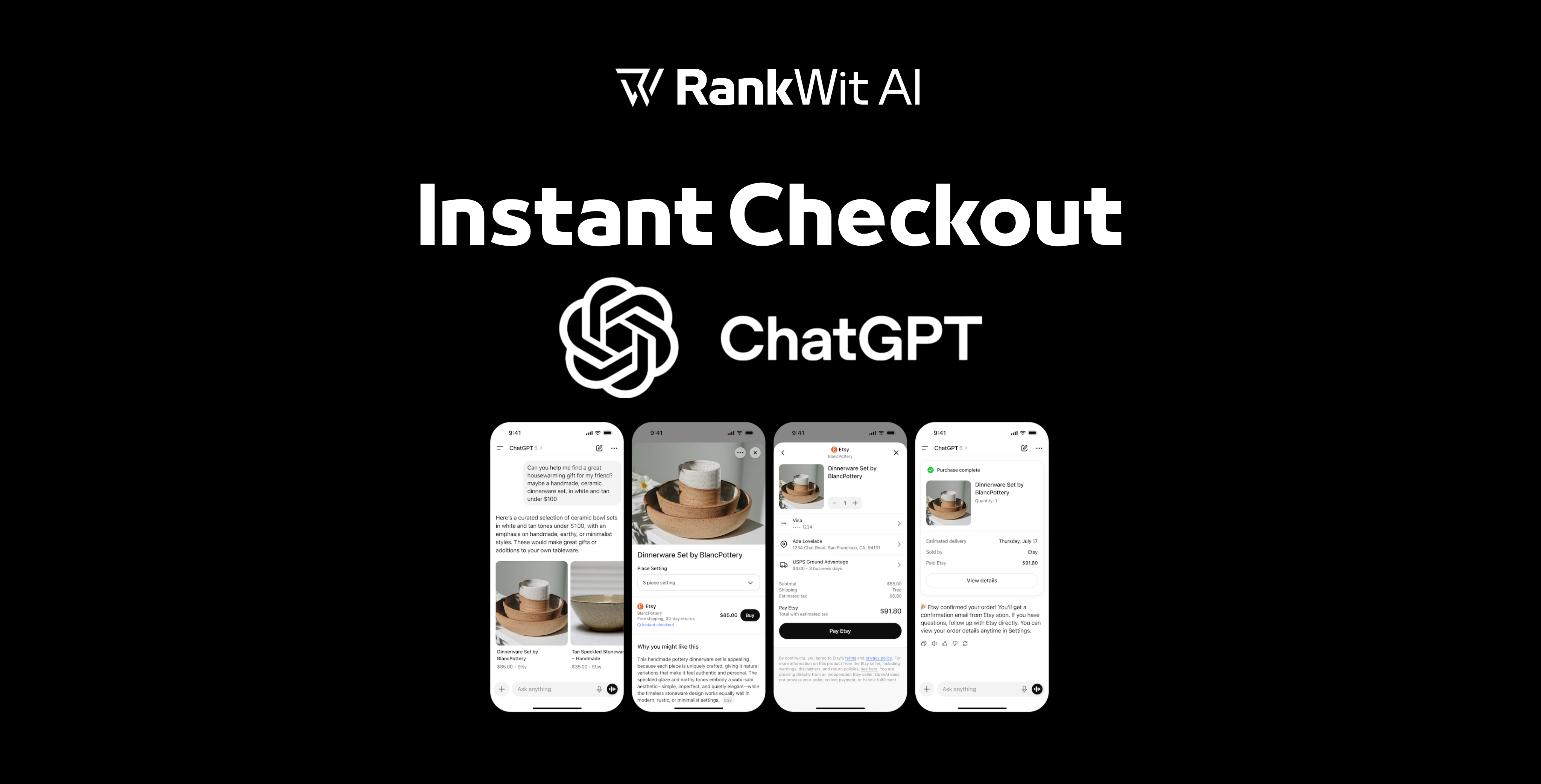
As of now, ChatGPT Instant Checkout is available only for merchants operating in the United States.
If your online store runs on Shopify or Etsy, you can already take advantage of this feature without any additional implementation, since these platforms are directly supported by OpenAI’s infrastructure.
For custom-built or enterprise e-commerce systems, a dedicated integration following the Agentic Commerce Protocol (ACP) is required.
Rankwit can assist your team in developing this integration—allowing you to access the U.S. market immediately and prepare for future international expansion as OpenAI rolls out the program globally.
Training a Large Language Model involves feeding it enormous volumes of text data, from books and blogs to academic papers and web content.
This data is tokenized (split into smaller parts like words or subwords), and then processed through multiple layers of a deep learning model.
Over time, the model learns statistical relationships between words and phrases. For example, it learns that “coffee” often appears near “morning” or “caffeine.” These associations help the model generate text that feels intuitive and human.
Once the base training is done, models are often fine-tuned using additional data and human feedback to improve accuracy, tone, and usefulness. The result: a powerful tool that understands language well enough to assist with everything from SEO optimization to natural conversation.
AI search performance metrics are the new frontier for digital marketers. As generative engines like Gemini and Search Generative Experience (SGE) redefine how users find information, relying solely on legacy SEO tracking is no longer enough. To succeed, you must measure how AI models perceive, rank, and cite your content.
1. Subjective ImpressionThis metric evaluates how well your content answers user queries compared to competitors. AI models assess the relevance, completeness, and accuracy of your content. A high score signifies that your content provides comprehensive answers that LLMs deem most helpful to the user.
2. Position ScoreSimilar to traditional SERP rankings, the Position Score measures how high your website ranks within the AI’s generated response. Calculated by your average ranking position (1st, 2nd, 3rd), a higher position directly correlates with increased user trust and higher click-through potential from AI citations.
3. Share of Voice (SoV)In the context of GEO, Share of Voice measures the percentage of queries where your website is mentioned or cited in the AI's response. A dominant SoV indicates broad topical authority and ensures your brand remains "top of mind" for the AI across various related search strings.
4. Consistency ScoreBecause users interact with various models (Perplexity, ChatGPT, Gemini), the Consistency Score is vital. It tracks the similarity of your rankings and mentions across multiple platforms. High consistency ensures that your brand’s authority is recognized universally, regardless of the specific AI model used.
RankWit is designed for anyone who wants to maximize their brand’s visibility on AI platforms. The main users include:
- Freelancers: Stand out by offering clients AI-optimized content services.
- Agencies: Add GEO to your service portfolio and stay ahead of competitors.
- Brands: Protect and expand your presence so that AI cites your company, not someone else’s.
Whether you work independently or as part of a larger marketing team, RankWit provides tools to monitor, optimize, and grow in the age of AI search.
At Rankwit, we specialize in helping merchants take advantage of OpenAI’s Agentic Commerce Protocol (ACP).
Our team manages the entire integration lifecycle, from mapping your product catalog to OpenAI’s structured feed specification, to building the checkout API endpoints and connecting secure payment providers like Stripe.
By partnering with Rankwit, your business can:
We tailor solutions to both enterprise and custom e-commerce platforms, ensuring a scalable and future-ready architecture.
Shopping Research is a feature in ChatGPT that acts as a personalized shopping assistant.
Simply describe what you’re looking for, such as “a lightweight laptop for travel”, and ChatGPT gathers product details, reviews, specs, prices, and comparisons from the web.
You can refine the results by marking products as “Not interested” or “More like this”, helping ChatGPT understand your preferences.
At the end, you receive a custom buyer’s guide that explains the pros, cons, and trade-offs of each option, making your purchase process easier and more informed.