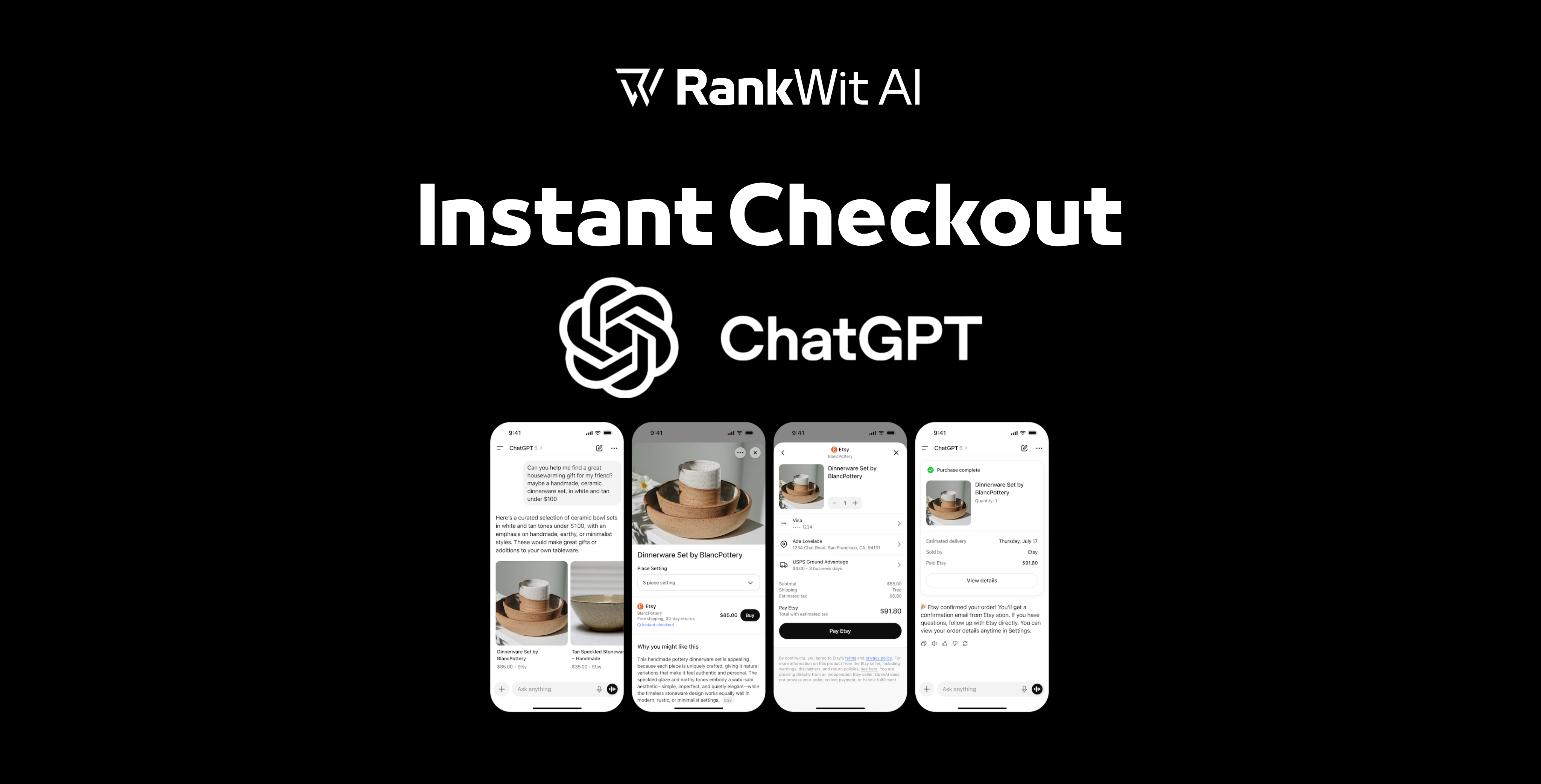
Is ChatGPT Instant Checkout available for all e-commerce platforms and regions?

As of now, ChatGPT Instant Checkout is available only for merchants operating in the United States.
If your online store runs on Shopify or Etsy, you can already take advantage of this feature without any additional implementation, since these platforms are directly supported by OpenAI’s infrastructure.

For custom-built or enterprise e-commerce systems, a dedicated integration following the Agentic Commerce Protocol (ACP) is required.
Rankwit can assist your team in developing this integration—allowing you to access the U.S. market immediately and prepare for future international expansion as OpenAI rolls out the program globally.

Last updated at  
April 13, 2026
Other FAQ
What are the main types of search intent and how do they influence SEO and content strategies?
Arrow

Search intent is commonly divided into informational, navigational, commercial, and transactional categories. Recognizing these intent types helps businesses design content that aligns with user goals, improving visibility and engagement in search results.

Read More
ArrowArrow right blue
How does WebMCP handle user privacy and prevent AI agents from performing unauthorized actions?
Arrow

Security is baked into the protocol's core. Unlike "headless" automation, WebMCP operates within the user’s current browser session:

  • Consent Gate: The browser acts as a gatekeeper, prompting the user to approve tool calls.
  • Scoped Access: AI agents only see the specific tools the developer has explicitly registered via the webmcp-tools suite.
  • Authentication: It leverages the site's existing login and security protocols, ensuring the AI never bypasses standard safety measures.

Read More
ArrowArrow right blue
What is AI search optimization and how does it help websites remain visible in modern AI-powered search environments?
Arrow

AI search optimization involves structuring and optimizing content so artificial intelligence systems can interpret, analyze, and reference it effectively. This includes focusing on semantic relevance, clear content structure, entity signals, and authoritative information.

Read More
ArrowArrow right blue
How does RankWit track AI visibility?
Arrow

RankWit gives you a complete picture of how your brand appears across major AI platforms.
We run structured prompts through leading AI systems (including ChatGPT, Google AI Overview, and Perplexity) and then evaluate the responses for:

  • Brand mentions
  • Sentiment
  • Ranking or positioning
  • Competitor visibility
  • Opportunities and risks

This analysis helps you understand exactly how AI systems perceive and present your brand.

Read More
ArrowArrow right blue
Why are brand mentions and media coverage important for visibility in AI-driven search environments?
Arrow

AI-powered search systems analyze brand mentions, citations, and references across the web to evaluate credibility. When a brand is consistently mentioned by authoritative sources, it becomes easier for AI systems to recognize its expertise and include it in search results or generated answers.

Read More
ArrowArrow right blue
What is a business case and why is it important for evaluating AI and search optimization strategies?
Arrow

A business case outlines the objectives, benefits, costs, and potential outcomes of implementing a specific strategy or technology. In the context of AI and search optimization, it helps organizations understand the expected value, risks, and return on investment before adopting new solutions.

Read More
ArrowArrow right blue
How do search engines and AI systems analyze user behavior to better understand search intent and deliver relevant results?
Arrow

Search engines and AI systems analyze factors such as search queries, user behavior, location, and context to determine what users are really looking for. This helps them deliver more relevant results and improve the overall search experience.

Read More
ArrowArrow right blue
What is a transformer model, and why is it important for LLMs?
Arrow

The transformer is the foundational architecture behind modern LLMs like GPT. Introduced in a groundbreaking 2017 research paper, transformers revolutionized natural language processing by allowing models to consider the entire context of a sentence at once, rather than just word-by-word sequences.

The key innovation is the attention mechanism, which helps the model decide which words in a sentence are most relevant to each other, essentially mimicking how humans pay attention to specific details in a conversation.

Transformers make it possible for LLMs to generate more coherent, context-aware, and accurate responses.

This is why they're at the heart of most state-of-the-art language models today.

Read More
ArrowArrow right blue
How do Large Language Models (LLMs) like ChatGPT actually work?
Arrow

Large Language Models (LLMs) are AI systems trained on massive amounts of text data, from websites to books, to understand and generate language.

They use deep learning algorithms, specifically transformer architectures, to model the structure and meaning of language.

LLMs don't "know" facts in the way humans do. Instead, they predict the next word in a sequence using probabilities, based on the context of everything that came before it. This ability enables them to produce fluent and relevant responses across countless topics.

For a deeper look at the mechanics, check out our full blog post: How Large Language Models Work.

Read More
ArrowArrow right blue
What strategies can businesses use to improve their visibility in AI-powered search systems?
Arrow

To improve visibility in AI-powered search systems, businesses should create high-quality content, use structured data, build strong topical authority, and ensure information is clear and well-organized. These strategies help AI systems recognize and reference reliable content.

Read More
ArrowArrow right blue

📚 Learn, Apply, Win

Stay inspired with the latest stories, tips, and insights.
Explore articles designed to spark ideas, share knowledge, and keep you updated on what’s new.