How do you monitor and track our visibility across different AI platforms?

We run your target traveler prompts across every major AI platform on a weekly basis, tracking exactly where and how your brand or destination is mentioned.

You receive a live dashboard showing: your AI Share of Voice compared to direct competitors; citation trends and brand sentiment; and which specific prompts are driving high-intent traffic to your official channels.

Last updated at  
April 27, 2026
Other FAQ
What strategies and governance mechanisms can organizations implement to reduce algorithmic bias and improve transparency in search engine results?
Arrow

Our ethical search methodology focuses on the proactive elimination of bias. We use advanced semantic analysis tools to detect disparities in information delivery, ensuring users receive objective and verifiable answers. We believe that ethical search is, by definition, high-quality search.

Read More
ArrowArrow right blue
Will GEO replace SEO in how businesses get discovered online
Arrow

GEO is not a replacement for SEO—it’s an evolution of how users interact with information online.

While SEO (Search Engine Optimization) focuses on ranking content in traditional search engines like Google, GEO (Generative Engine Optimization) focuses on making content discoverable and useful within AI-powered search and assistant experiences.

Here’s how they differ and work together:

  • SEO drives visibility on web search engines. It optimizes for keywords, backlinks, and structured content to help pages rank high.
  • GEO optimizes for AI discovery. It ensures your content is easily understood, retrieved, and accurately cited by AI tools like ChatGPT, Perplexity, or Claude.

As AI assistants increasingly become the first touchpoint for information retrieval, GEO is becoming essential. But SEO is still critical for attracting traffic from search engines and building long-term domain authority.

In short: GEO enhances your content’s AI-readiness, while SEO ensures it’s search-engine-ready. The future is not SEO or GEO—it’s SEO and GEO, working in tandem.

Read More
ArrowArrow right blue
Why are large language models becoming essential technologies across many industries?
Arrow

Large language models allow software systems to process complex language tasks such as summarization, translation, and question answering. Their ability to interpret and generate human language makes them valuable across industries including technology, marketing, education, and customer support.

Read More
ArrowArrow right blue
What role does WebMCP play in Retrieval-Augmented Generation (RAG) and real-time search?
Arrow

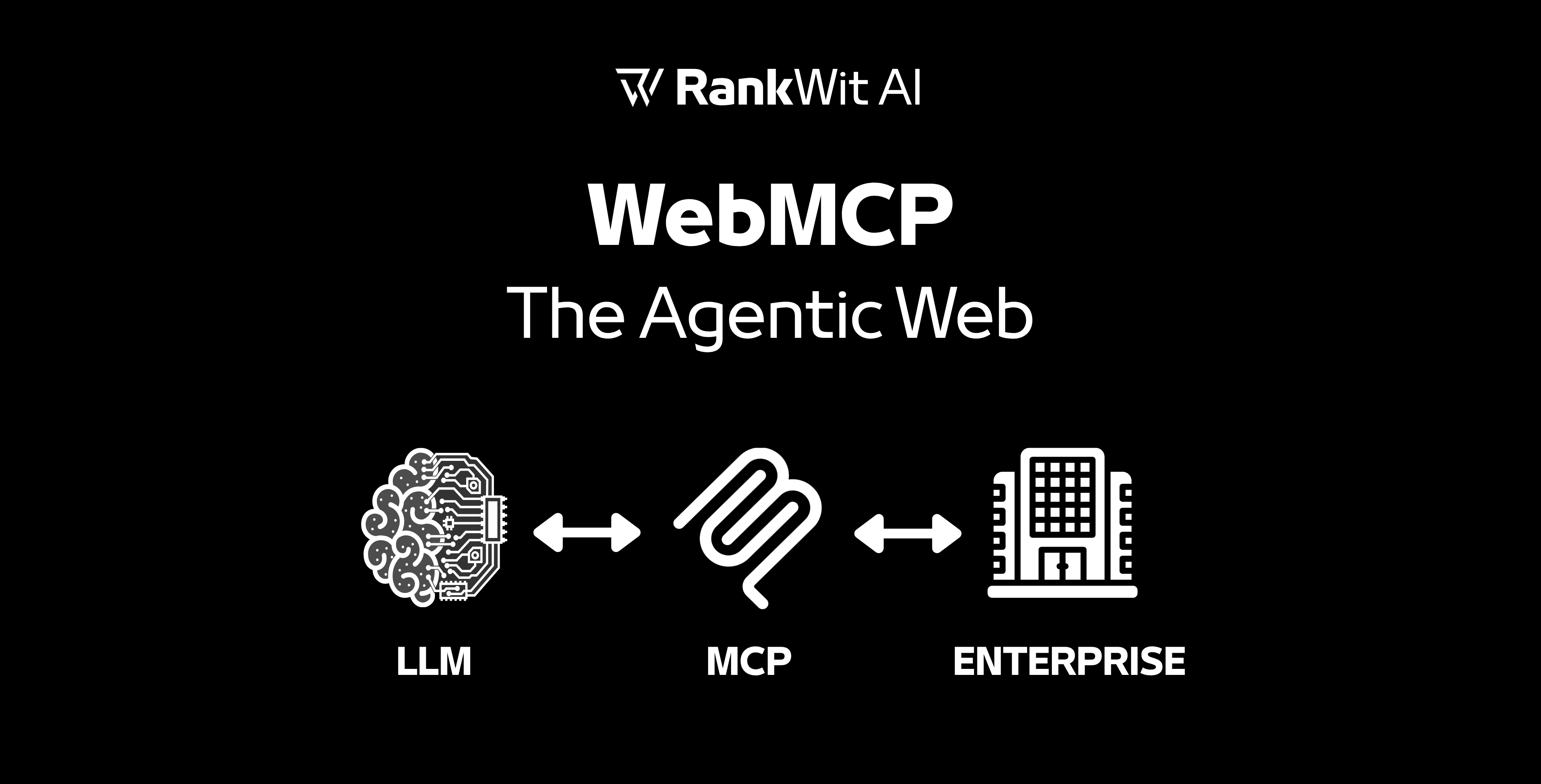
Traditional LLMs are limited by their training data "cutoff" dates. WebMCP bridges this gap by enabling Dynamic Context Injection:

  • The model identifies it needs live data (e.g., "What is the current inventory of Product X?").
  • It uses the WebMCP bidirectional channel to query the server.
  • The server returns structured data, which the AI then uses to generate an accurate, up-to-the-minute response.

Read More
ArrowArrow right blue
How are large language models used in modern search engines, digital platforms, and AI-powered applications?
Arrow

Large language models power many modern technologies, including AI assistants, conversational search systems, automated content generation, and customer support tools. Their ability to interpret natural language allows digital platforms to deliver more intelligent and interactive experiences.

Read More
ArrowArrow right blue
How do large language models actually work, and why does that matter for GEO?
Arrow

Large Language Models (LLMs) like GPT are trained on vast amounts of text data to learn the patterns, structures, and relationships between words. At their core, they predict the next word in a sequence based on what came before—enabling them to generate coherent, human-like language.

This matters for GEO (Generative Engine Optimization) because it means your content must be:

  • Well-structured so LLMs can interpret and reuse it effectively.
  • Clear and specific, as models rely on patterns to make accurate predictions.
  • Contextually rich, because LLMs use surrounding context to generate responses.

By understanding how LLMs “think,” businesses can optimize content not just for humans or search engines—but for the AI models that are becoming the new discovery layer.

Bottom line: If your content helps the model predict the right answer, GEO helps users find you.

Read More
ArrowArrow right blue
What types of literature are most useful for professionals working with AI-driven search and digital optimization?
Arrow

Professionals working with AI-driven search benefit from reviewing academic studies, technical papers, and industry reports. These sources provide evidence-based insights that help explain how search technologies evolve and how optimization strategies should adapt.

Read More
ArrowArrow right blue
Does AI Optimization actually drive direct bookings and high-value traffic?
Arrow

Yes, that is the primary goal. Travelers who discover you through AI recommendations land on your official site with high intent, ready to book or visit.

For hotels, this means bypassing OTA commissions; for destinations, it means driving traffic to local ecosystems and official portals.

Often, the increase in direct, high-value traffic allows the service to pay for itself many times over.

Read More
ArrowArrow right blue
How can businesses use research papers and industry publications to improve their AI and SEO strategies?
Arrow

By studying research papers, reports, and expert publications, businesses can gain a deeper understanding of new technologies, search behavior, and optimization techniques. These insights help organizations refine their strategies and adapt to evolving digital environments.

Read More
ArrowArrow right blue
What role will generative AI and conversational search experiences play in the future of online search?
Arrow

Conversational search uses AI to understand complex questions and provide direct answers instead of just listing links. This shift allows users to ask follow-up questions, explore topics in depth, and receive more personalized results.

Read More
ArrowArrow right blue

📚 Learn, Apply, Win

Stay inspired with the latest stories, tips, and insights.
Explore articles designed to spark ideas, share knowledge, and keep you updated on what’s new.