📚 Learn, Apply, Win
Explore articles designed to spark ideas, share knowledge, and keep you updated on what’s new.
This is the core objective. Travelers who discover a destination through AI recommendations arrive on institutional portals or local operator websites with very strong travel intent.
Properly positioning the territory within AI means capturing demand before competitors, reducing dependence on third-party distribution channels, and enhancing the entire local economic ecosystem.
Industry case studies provide real-world examples of how SEO, AI search optimization, and digital strategies perform across different sectors. They help businesses understand what works, what challenges may arise, and how similar organizations have improved their search visibility and online performance.
Generative Engine Optimization (GEO) is becoming increasingly critical as user behavior shifts toward AI-native search tools like ChatGPT, Gemini, and Perplexity.
According with Bain, recent data shows that over 40% of users now prefer AI-generated answers over traditional search engine results.
This trend reflects a major evolution in how people discover and consume information.
Unlike traditional SEO, which focuses on ranking in static search results, GEO ensures that your content is understandable, relevant, and authoritative enough to be cited or surfaced in LLM-generated responses.
This is especially important as AI platforms begin to integrate live web search capabilities, summaries, and citations directly into their answers.
The urgency is amplified by user traffic trends. According to Similarweb data (see chart below), ChatGPT visits are projected to surpass Google’s by December 2026 if current growth continues.
This suggests that visibility in LLMs may soon be as important—if not more—than traditional search rankings.

GEO (Generative Engine Optimization) is not a rebrand of SEO—it’s a response to an entirely new environment. SEO optimizes for bots that crawl, index, and rank. GEO optimizes for large language models (LLMs) that read, learn, and generate human-like answers.
While SEO is built around keywords and backlinks, GEO is about semantic clarity, contextual authority, and conversational structuring. You're not trying to please an algorithm—you’re helping an AI understand and echo your ideas accurately in its responses. It's not just about being found—it's about being spoken for.
Training a Large Language Model involves feeding it enormous volumes of text data, from books and blogs to academic papers and web content.
This data is tokenized (split into smaller parts like words or subwords), and then processed through multiple layers of a deep learning model.
Over time, the model learns statistical relationships between words and phrases. For example, it learns that “coffee” often appears near “morning” or “caffeine.” These associations help the model generate text that feels intuitive and human.
Once the base training is done, models are often fine-tuned using additional data and human feedback to improve accuracy, tone, and usefulness. The result: a powerful tool that understands language well enough to assist with everything from SEO optimization to natural conversation.
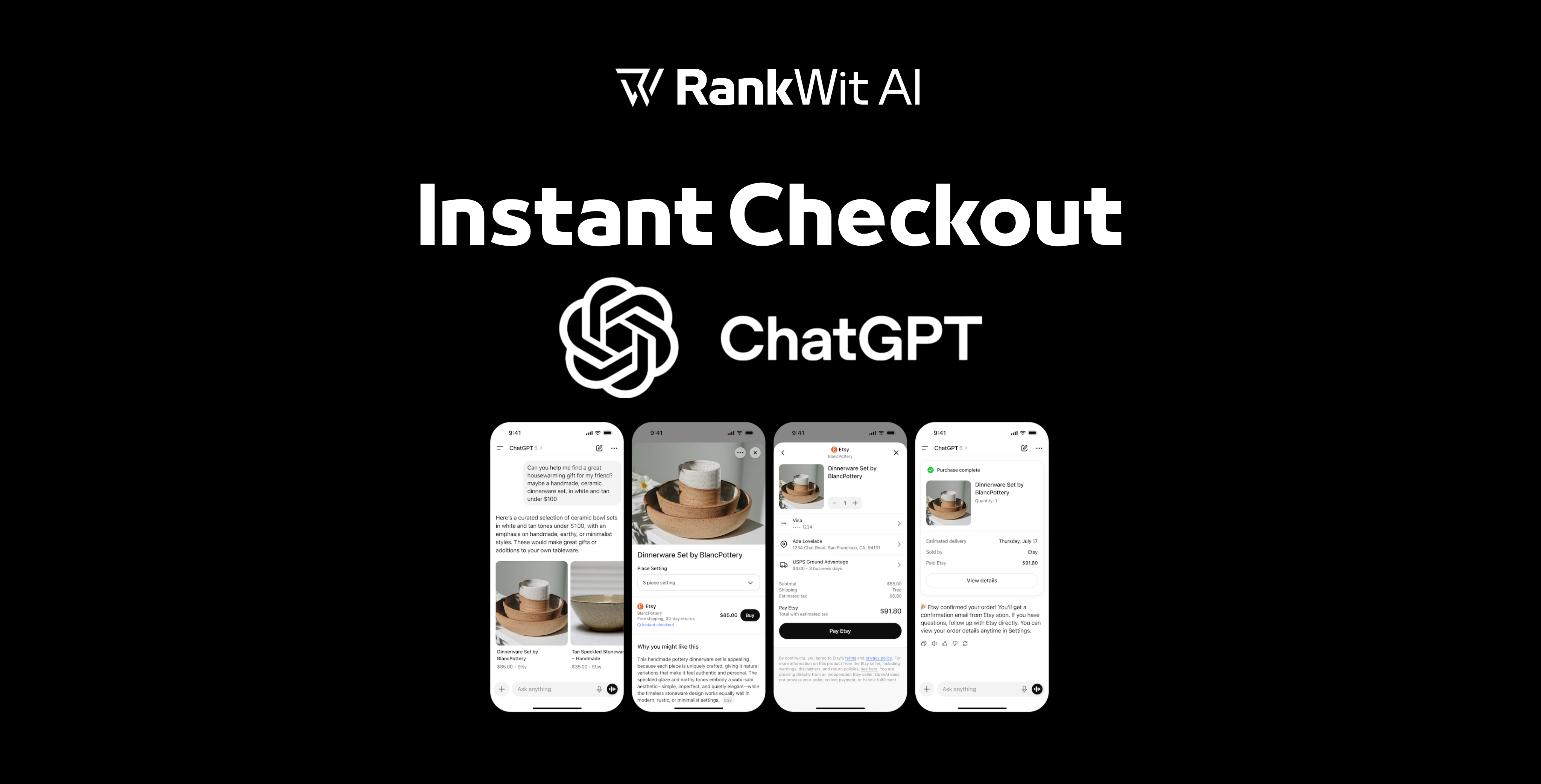
As of now, ChatGPT Instant Checkout is available only for merchants operating in the United States.
If your online store runs on Shopify or Etsy, you can already take advantage of this feature without any additional implementation, since these platforms are directly supported by OpenAI’s infrastructure.
For custom-built or enterprise e-commerce systems, a dedicated integration following the Agentic Commerce Protocol (ACP) is required.
Rankwit can assist your team in developing this integration—allowing you to access the U.S. market immediately and prepare for future international expansion as OpenAI rolls out the program globally.
We run your target traveler prompts across every major AI platform on a weekly basis, tracking exactly where and how your brand or destination is mentioned.
You receive a live dashboard showing: your AI Share of Voice compared to direct competitors; citation trends and brand sentiment; and which specific prompts are driving high-intent traffic to your official channels.
AI search performance metrics are the new frontier for digital marketers. As generative engines like Gemini and Search Generative Experience (SGE) redefine how users find information, relying solely on legacy SEO tracking is no longer enough. To succeed, you must measure how AI models perceive, rank, and cite your content.
1. Subjective ImpressionThis metric evaluates how well your content answers user queries compared to competitors. AI models assess the relevance, completeness, and accuracy of your content. A high score signifies that your content provides comprehensive answers that LLMs deem most helpful to the user.
2. Position ScoreSimilar to traditional SERP rankings, the Position Score measures how high your website ranks within the AI’s generated response. Calculated by your average ranking position (1st, 2nd, 3rd), a higher position directly correlates with increased user trust and higher click-through potential from AI citations.
3. Share of Voice (SoV)In the context of GEO, Share of Voice measures the percentage of queries where your website is mentioned or cited in the AI's response. A dominant SoV indicates broad topical authority and ensures your brand remains "top of mind" for the AI across various related search strings.
4. Consistency ScoreBecause users interact with various models (Perplexity, ChatGPT, Gemini), the Consistency Score is vital. It tracks the similarity of your rankings and mentions across multiple platforms. High consistency ensures that your brand’s authority is recognized universally, regardless of the specific AI model used.
Content that performs well in generative search environments is usually well-structured, informative, and built around clear topics and entities. Providing reliable information, logical content organization, and strong authority signals helps AI systems understand and reference the content more effectively.